
News

SimWorks releases SimWorks Finite Difference Solutions version 3.7.0

SimWorks releases SimWorks Finite Difference Solutions version 3.7.0

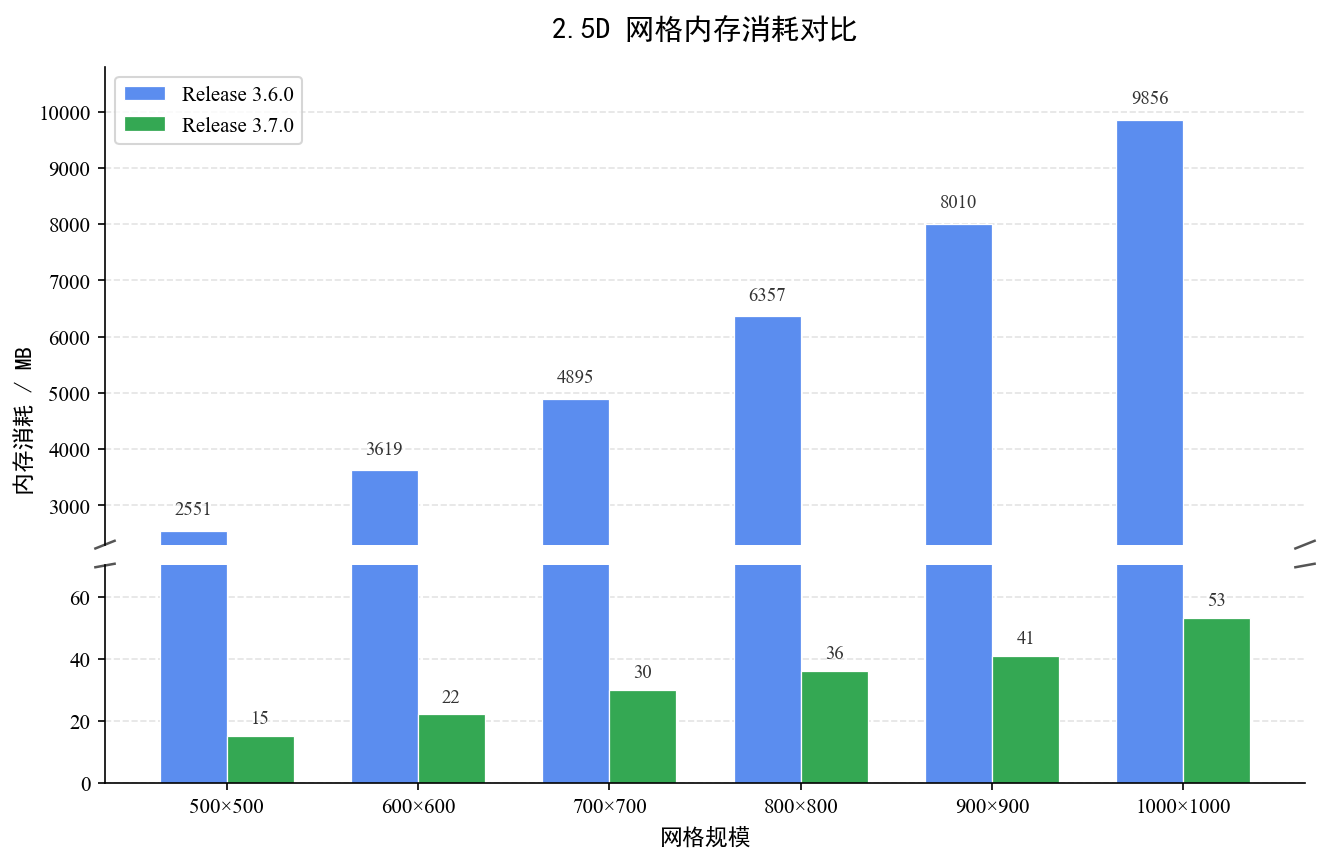
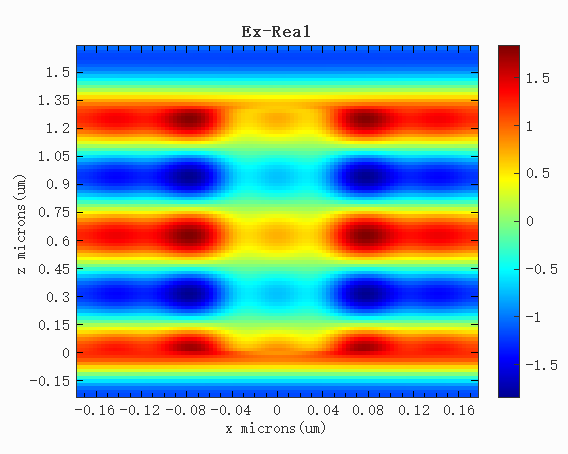
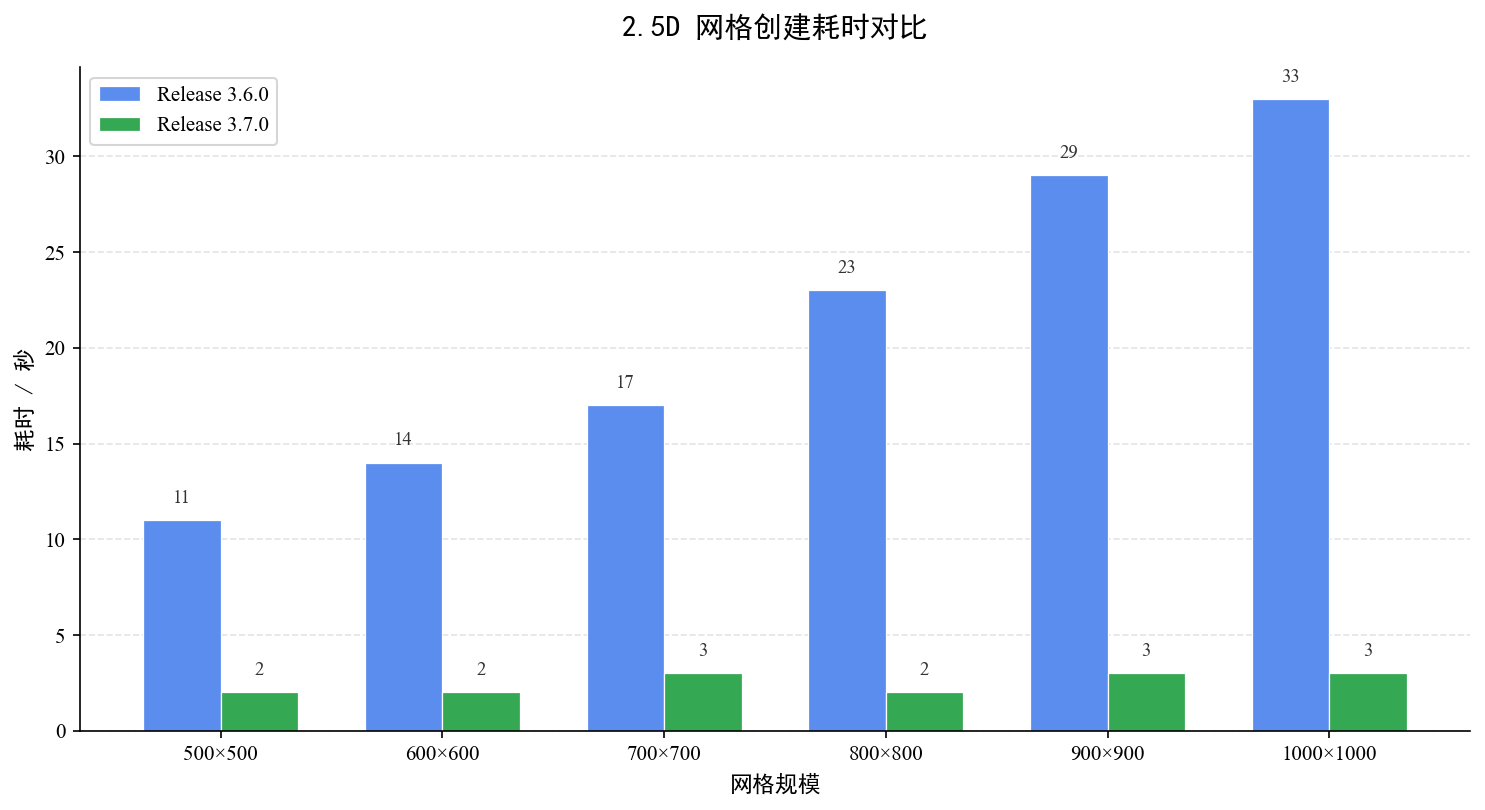
Dear users: Thank you all for your attention and support to the SimWorks software. To further optimize the user experience and enhance the simulation quality, this software has been updated to version 3.7.0. **The key update contents this time are:** ## RCWA Solver Enhancements This update further improves the _RCWA_ solver with enhancements in field distribution monitoring and propagation direction settings, expanding the analysis scope and modeling flexibility for periodic structure simulations—applicable to gratings, waveguide gratings, metasurfaces, and multilayer periodic structures. Key updates include: - **New _RCWA Field Monitor_** Supports viewing the frequency-domain field distribution at arbitrary locations within the simulation region. Users can add _Field Monitor_ objects in an _RCWA_ project, specify the monitoring location and frequency range, and obtain the electric field, magnetic field, and other frequency-domain responses at that point for analyzing field distributions, resonant modes, and local field enhancement inside periodic structures. This extends _RCWA_ analysis beyond global optical responses (reflectance, transmittance, diffraction efficiency, etc.) to spatial field distributions, facilitating cross-validation against _FDTD_ results; see the figure below for an example. ![](https://simworksofficial-files.oss-cn-beijing.aliyuncs.com/mdfile/resources/img/RCWA_monitor_field.png) - **New _backward_ and _both_ propagation directions** The _backward_ mode is suitable for analyzing incidence from the rear side of the structure; the _both_ mode computes both forward and backward propagation responses simultaneously, facilitating comparative studies of symmetric structures or bidirectionally coupled devices. ## New `stackdipole` and `stackpurcell` Script Commands in the `Stack` Series The `Stack` script series adds two new commands, `stackdipole` and `stackpurcell`, extending the analytical computation capabilities for planar multilayer film structures beyond `stackrt` and `stackfield`: - `stackdipole`: Computes the radiation properties of an electric dipole embedded in a multilayer film stack, including radiated power and directivity, for analyzing dipole emission in microcavities, waveguides, and thin-film devices. - `stackpurcell`: Computes the Purcell factor (spontaneous emission rate enhancement factor) for a dipole in a multilayer environment, for evaluating how surrounding structures modulate emission rates—relevant to metal/dielectric interfaces, microcavities, OLEDs, and related devices. These commands follow the same transfer matrix method (TMM) approach as the existing `Stack` series: fast analytical computation without mesh generation, well suited to parameter sweeps and optimization. They are applicable to quantum optics, microcavity emission, Purcell effect studies, and near-field coupling research and design. ## 2.5D Mesh Generation Performance Optimization This update significantly optimizes 2.5D mesh generation speed and reduces memory consumption, accelerating mesh building and subsequent simulation preparation for large-scale 2.5D projects. In tests from 500 $\times$ 500 to 1000 $\times$ 1000 mesh sizes, Release 3.7.0 compared with Release 3.6.0 achieves an overall 5–10 $\times$ improvement in mesh creation; average memory usage drops by over 99%. See the figures below for details. ![](https://simworksofficial-files.oss-cn-beijing.aliyuncs.com/mdfile/resources/img/mesh_time_comparison.png) ![](https://simworksofficial-files.oss-cn-beijing.aliyuncs.com/mdfile/resources/img/mesh_memory_comparison_broken.png) Complete update content see - [Release Notes](https://www.simworks.net/en/release-note/-/v3.7), Welcome users to download to use - [Customer Downloads](https://www.simworks.net/en/trial-instruction) ! Shandong Guangfang Software Company has been deeply engaged in the development of optical simulation software for many years, committed to providing more professional and efficient simulation services. Once again, we thank you all for your attention and look forward to your feedback and valuable suggestions!
2026-08-31 17:51:25
Details
SimWorks releases SimWorks Finite Difference Solutions version 3.6.0

SimWorks releases SimWorks Finite Difference Solutions version 3.6.0

Dear users: Thank you all for your attention and support to the SimWorks software. To further optimize the user experience and enhance the simulation quality, this software has been updated to version 3.6.0. **The key update contents this time are:** ## New RCWA Solver and Corresponding Script Capabilities The new _RCWA_ solver is a semi-analytical simulation tool for analyzing the optical response of multilayer structures with periodic variations along the propagation direction under plane-wave incidence. It can compute reflectance, transmittance, and diffraction efficiency. The _RCWA_ solver is especially suitable for analyzing and designing periodic subwavelength structures such as diffraction gratings, metasurfaces, photonic crystal slabs, and waveguide gratings. Its core principle is to solve Maxwell's equations analytically in the Fourier domain for each layer, using the number of K vectors (i.e., Fourier-mode wave vectors) to balance simulation accuracy and speed. Increasing the number of K vectors improves accuracy; for structures with complex boundaries or high refractive-index contrast, it is recommended to increase the number and perform convergence testing. Once sufficiently converged, the _RCWA_ results are highly consistent with _FDTD_. In terms of scripting support, the new `addrcwa` command is used to create an _RCWA_ solver, and the `run` script has also been extended to support _RCWA_ solving tasks. This allows users to seamlessly integrate _RCWA_ models into existing scripted parameter sweeps and batch automated simulation workflows, further improving design and optimization efficiency. ![](https://simworksofficial-files.oss-cn-beijing.aliyuncs.com/mdfile/resources/img/RCWA_solver.png) ## New Support for Diagonal Anisotropic Materials in `Stack` Script Functions This update extends the calculation capabilities of `stackrt` and `stackfield` for diagonal anisotropic (including birefringent) materials: - `stackrt` supports both uniaxial and biaxial anisotropic layers. For uniaxial materials with the optical axis along the z direction (nx = ny), the three principal refractive indices [nx, ny, nz] can be specified directly. For more complex biaxial materials (nx ≠ ny), a full $3 \times 3$ refractive-index tensor in diagonal form (with zero off-diagonal elements) must be provided. Both input methods support dispersive materials, allowing the refractive index to be specified independently at each frequency point. The corresponding output results additionally include cross-polarization components. - `stackfield` supports the field distribution in uniaxial anisotropic media: it now supports uniaxial materials with the optical axis along the z direction (nx = ny), allowing the electric and magnetic field distributions inside anisotropic layers to be computed. These updates make the `Stack` script functions more accurate for simulating diagonal anisotropic thin-film structures such as liquid crystals and crystals, expanding their application scenarios in polarization optics and birefringent device design. ![](https://simworksofficial-files.oss-cn-beijing.aliyuncs.com/mdfile/resources/img/stackrt_anisotropic_slab.png) ## Conformal Mesh Refinement Method Optimization This update optimizes the conformal mesh refinement method, improving accuracy while significantly accelerating mesh generation speed. The method performs precise equivalent material parameter calculations for subgrid cells (subcells), and is particularly suitable for meshing at multi-material interfaces. It effectively reduces meshing difficulty and computational resource consumption while maintaining or improving simulation accuracy. If simulation results appear anomalous, you can uncheck the _use geometric volume fraction method for mesh conformal_ option to revert to the traditional conformal mesh refinement approach. ![](https://simworksofficial-files.oss-cn-beijing.aliyuncs.com/mdfile/resources/img/vpep_mesh_en.png) Complete update content see - [Release Notes](https://www.simworks.net/en/release-note/-/v3.6), Welcome users to download to use - [Customer Downloads](https://www.simworks.net/en/trial-instruction) ! Shandong Guangfang Software Company has been deeply engaged in the development of optical simulation software for many years, committed to providing more professional and efficient simulation services. Once again, we thank you all for your attention and look forward to your feedback and valuable suggestions!
2026-07-31 16:27:11
Details
SimWorks releases SimWorks Finite Difference Solutions version 3.5.0

SimWorks releases SimWorks Finite Difference Solutions version 3.5.0

Dear users: Thank you all for your attention and support to the SimWorks software. To further optimize the user experience and enhance the simulation quality, this software has been updated to version 3.5.0. **The key update contents this time are:** #### New `stack` Script Commands: Rapid Calculation of Optical Response for Planar Multilayer Film Stacks The new `stack` script commands provide fast analytical computation of the optical response of one-dimensional multilayer film structures based on the transfer matrix method (TMM). For dielectric structures that are laterally uniform and only layered along the thickness direction, this method assigns a transfer matrix to each layer, obtains the overall transfer matrix through matrix multiplication, and finally solves for reflectance, transmittance, and field distribution. This series currently includes the following two script commands: - `stackrt`: Calculates reflectance and transmittance under plane-wave incidence, returning power ratios and coefficients for S/P polarization. - `stackfield`: Computes the electric and magnetic field distribution inside the multilayer structure, supporting analysis of standing-wave patterns, absorption profiles, and field enhancement effects. Users only need to input the refractive index, thickness, frequency, and incidence angle of each layer to obtain results quickly. This command series is suitable for rapid preliminary evaluation in scenarios such as film design, VCSELs, OLEDs, and Bragg grating mirrors. The `stack` script functions offer significant advantages including high computation speed, no need for mesh generation, and high numerical accuracy, making them especially suitable for parameter sweeps and optimization iterations. The following figure shows the schematic principle and validation of calculation results for `stackrt`: ![](https://simworksofficial-files.oss-cn-beijing.aliyuncs.com/mdfile/resources/img/stackrt_R_T.png) #### New Assembly Group Feature The Assembly Group is a special group type designed for efficiently creating complex structures composed of a large number of repeated or similar objects, such as metalens arrays. Its core concept is "define once, reuse multiple times"—by using a prototype object and a parameter mapping table, users can generate multiple instances in batch, significantly improving geometric construction and mesh generation speed. This feature is fully driven by scripts (supporting commands such as `addassemblygroup`, `addtogroup`, `setnamed`), and includes a built-in variant management mechanism (rotation and translation are treated as free variables and do not consume variant slots), greatly simplifying the design and simulation workflow for large-scale periodic or quasi-periodic structures. ![](https://simworksofficial-files.oss-cn-beijing.aliyuncs.com/mdfile/resources/img/assembly_group.png) #### New Conformal Variant CP‑EP0 Conformal Mesh Method CP‑EP0 (Contour Path Effective Permittivity 0) is a high‑accuracy conformal mesh technique for dielectric interfaces. For interface segments within a mesh cell, it weights contributions along the wave propagation direction (e.g., z‑axis) by length ratio and on the cross‑sectional plane (e.g., xy‑plane) by area ratio, thereby computing the equivalent permittivity of each cell accurately. This method can precisely capture curved interfaces of three‑dimensional complex structures even with a coarse mesh, significantly reducing meshing difficulty and memory consumption. For dielectric optoelectronic devices with curved boundaries—such as microlenses, waveguide couplers, and curved multilayer films—CP‑EP0 describes the interface refractive index distribution more accurately and faster than traditional volume‑averaged (V‑EP) and polarization‑dependent (VP‑EP) methods, making it an ideal choice for such scenarios. ![](https://simworksofficial-files.oss-cn-beijing.aliyuncs.com/mdfile/resources/img/cp-ep0_compare_vp-ep0.png) #### Custom Time Signals for Light Sources via Script The new `setsourcesignal` script command allows users to specify a custom time‑domain pulse waveform for an existing light source in the solver. This command does not create a new source; it only modifies the time‑domain signal of the existing source while preserving its geometry, position, and other physical attributes, thus offering flexible waveform replacement on top of the current source. This feature is mainly targeted at applications requiring precise control of pulse temporal shapes, such as nonlinear optical simulations. Users can define amplitude and phase based on arbitrary time sequences, enabling non‑standard injection waveforms like double pulses, chirped pulses, rectangular pulses, or arbitrary modulated waveforms, providing greater flexibility for research that requires custom pulse shapes. ![](https://simworksofficial-files.oss-cn-beijing.aliyuncs.com/mdfile/resources/img/custom_source_signal.png)Complete update content see - [Release Notes](https://www.simworks.net/en/release-note/-/v3.5), Welcome users to download to use - [Customer Downloads](https://www.simworks.net/en/trial-instruction) ! Shandong Guangfang Software Company has been deeply engaged in the development of optical simulation software for many years, committed to providing more professional and efficient simulation services. Once again, we thank you all for your attention and look forward to your feedback and valuable suggestions!
2026-06-30 14:38:31
Details
SimWorks releases SimWorks Finite Difference Solutions version 3.4.0

SimWorks releases SimWorks Finite Difference Solutions version 3.4.0

Dear users: Thank you all for your attention and support to the SimWorks software. To further optimize the user experience and enhance the simulation quality, this software has been updated to version 3.4.0. **The key update contents this time are:** #### EME Simulation Enhancement: New emesweep Rapid Sweep Function for Improved Efficiency and Fine Control The EME solver introduces the emesweep sweep functions, which through flexible parameter sweeps significantly reduce simulation time and device design cycles for large optical components: - **Propagation sweep**: Varies cell length to obtain the S‑matrix as a function of length. No need to recompute modes, resulting in very fast computation. - **Wavelength sweep**: Varies wavelength to obtain the trend of the S‑matrix with wavelength. This mode does not recompute modes and is suitable for scenarios where the mode field does not change significantly with wavelength. - **Mode convergence sweep**: Varies the maximum number of modes per cell to observe changes in the S‑matrix, used to assess mode convergence. - **Scripting support**: New `emesweep` script commands support the three sweep tasks (propagation, wavelength, mode convergence), corresponding one‑to‑one with the three sweep types described above. In addition, this release includes the following simulation details and operational improvements: - **UI upgrade**: Adds an EME Analysis Window with a two‑panel layout. The left panel focuses on core EME propagation parameters, while the right panel provides various emesweep analysis functions. - **Computational performance optimization**: Optimizes the EME Propagate calculation flow to further improve simulation speed. - **Dimensional and visualization enhancements**: Adds a *Solver spatial type* option to support custom propagation directions; adds a *Display cells* option to show or hide cell boundaries in the view, improving the visualization experience. - **Sweep and optimization**: The EME solver now fully supports sweep and optimization functions, allowing users to perform more diverse parameter searches in the optimization sweep window. ![](https://simworksofficial-files.oss-cn-beijing.aliyuncs.com/mdfile/resources/img/EME_sweep_analysis_window.png) Complete update content see - [Release Notes](https://www.simworks.net/en/release-note/-/v3.4), Welcome users to download to use - [Customer Downloads](https://www.simworks.net/en/trial-instruction) ! Shandong Guangfang Software Company has been deeply engaged in the development of optical simulation software for many years, committed to providing more professional and efficient simulation services. Once again, we thank you all for your attention and look forward to your feedback and valuable suggestions!
2026-05-29 18:55:12
Details
Exhibition Event | SimWorks Successfully Concludes Wuhan Optoelectronics Expo: Winning Trust Through Technological Iteration, Promoting Growth Through Collaboration

Exhibition Event | SimWorks Successfully Concludes Wuhan Optoelectronics Expo: Winning Trust Through Technological Iteration, Promoting Growth Through Collaboration

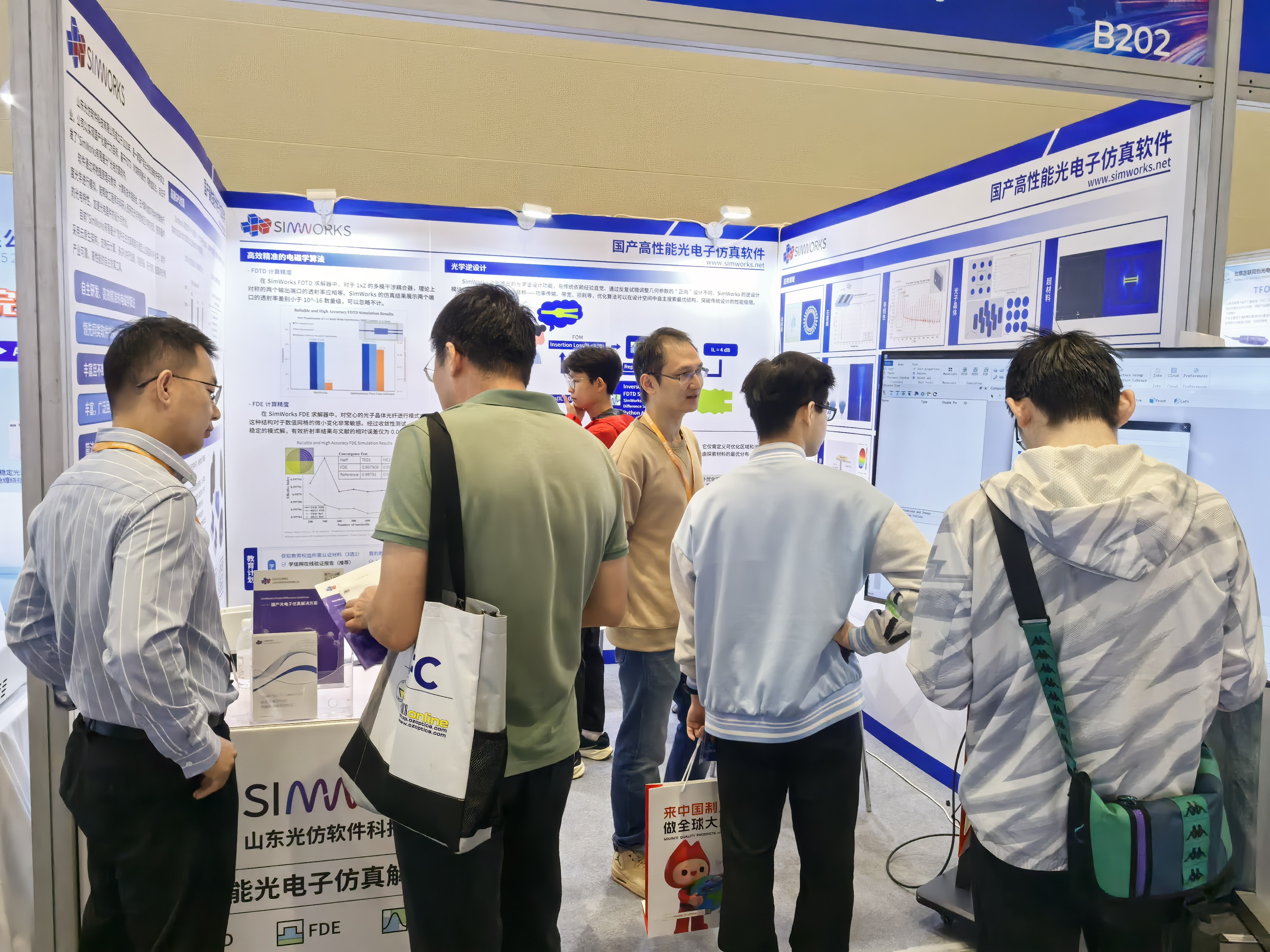
From May 18 to 20, 2026, SimWorks showcased its self-developed photoelectric simulation software, SimWorks, at the "Optics Valley" International Optoelectronic Exposition, drawing industry attention with its continuously iterated product strength, deep user trust, and open cooperation philosophy. ## Returning User Visits and Feedback During the exhibition, returning users such as **Hisilicon Optoelectronics, Shanghai Institute of Optics and Fine Mechanics (CAS), Huazhong University of Science and Technology, Westlake University, and Southern University of Science and Technology** visited the SimWorks booth. They showed interest in the version iteration progress of SimWorks, learning about improvements in computational efficiency, application scenario expansion, and functional optimization, and recognized the software's stability and innovation. This provides momentum for SimWorks to continue深耕 the field of photoelectric simulation and advance technological refinement. ![Description](https://simworksofficial-files.oss-cn-beijing.aliyuncs.com/jpg/20260525-131922_2026/05/25A012.jpg) ## New Exchanges and Collaborations with Enterprises and Universities During the exhibition, the SimWorks team engaged in discussions with industry peers and洽谈ed cooperation matters, achieving positive outcomes. At the enterprise level, representatives from **Wuhan Eryuan, Tianjin Huahui Core, Hangzhou Huaxin Optoelectronics**, and other photoelectric companies visited the booth. They discussed potential collaborations on the application of photoelectric simulation technology and industrial chain synergy, laying the groundwork for future cooperation. ![Description](https://simworksofficial-files.oss-cn-beijing.aliyuncs.com/jpg/20260525-131816_2026/05/25A015.jpg) At the university level, faculty and students from **The Chinese University of Hong Kong, Wuhan University of Technology, Wuhan Institute of Technology**, and other institutions visited the booth. They expressed interest in the software's development progress, its performance in catching up with international benchmarks, and its application and expansion in research projects. ![Description](https://simworksofficial-files.oss-cn-beijing.aliyuncs.com/jpg/20260525-132526_2026/05/25A014.jpg) ## Future Outlook During the exhibition, many sincere comments and suggestions were received. In the future, SimWorks will continue to focus on the field of photoelectric simulation, emphasizing version iteration and core function optimization to enhance product efficiency and accuracy, and working with industry peers to promote high-quality development of the photoelectric industry. ### Scan to Follow Our WeChat Service Account ### ![WeChat Service Account QR Code](https://simworksofficial-files.oss-cn-beijing.aliyuncs.com/png/image_2025/08/07A007.png){{{width=200px height=auto}}}
2026-05-22 15:41:19
Details
SimWorks releases SimWorks Finite Difference Solutions version 3.3.0

SimWorks releases SimWorks Finite Difference Solutions version 3.3.0

Dear users: Thank you all for your attention and support to the SimWorks software. To further optimize the user experience and enhance the simulation quality, this software has been updated to version 3.3.0. **The key update contents this time are:** #### New MCP Service: AI Large Language Model-Driven Natural Language Interaction To improve software intelligence and operational convenience, we officially introduce the MCP Service. Built on Anthropic's open-source Model Context Protocol (MCP) standard, this service establishes a standardized communication bridge between AI large language models and SimWorks software. The MCP Service empowers AI assistants with the ability to perceive the physical environment in real time, understand user intent, and execute complex commands. Through natural language interaction, the AI can automatically generate and execute SimWorks script commands, covering the entire workflow from solver configuration and light source setup to simulation execution. This capability significantly lowers the software adoption barrier while laying a solid foundation for automated workflows and intelligent design assistance. ![Description](https://simworksofficial-files.oss-cn-beijing.aliyuncs.com/gif/MCP_2026/04/29A018.gif) #### EME Solver Adds Periods and Energy Conservation Core Settings, Advancing Accuracy, Physical Consistency, and Periodic Array Modeling The Eigenmode Expansion (EME) solver now includes `Energy Conservation` and `Periods` settings, allowing users to more finely control simulation accuracy, physical consistency, and periodic structure handling. - **Periods (Periodic Structure Modeling)**: Greatly simplifies the setup of periodic array devices. Users no longer need to model hundreds of periods individually, simply define the period sequence and repetition count via the UI, and the solver automatically performs efficient expanded calculations. - **Energy Conservation**: Expand the policy options for energy conservation to suit more complex scenarios: - `none`: No energy conservation applied. - `make passive`: Automatically correct non-physical gain caused by numerical errors, ensure the S‑parameter matrix strictly satisfies passivity. Suitable for conventional passive device simulations. - `conserve energy`: Designed specifically for periodic devices such as Bragg gratings, enforcing perfect energy conservation correction on the interface S‑matrix. This effectively avoids simulation result distortion caused by the power‑law amplification of small errors over multiple periods, providing physically more reliable simulation data. ![Description](https://simworksofficial-files.oss-cn-beijing.aliyuncs.com/PNG/1280X1280_2026/04/30A005.PNG) #### New Surface Structure Users can now define surface contours using precise mathematical equations, with automatic generation of material volume either above or below the surface. This object integrates three definition methods: conic, polynomial, and custom equations, offering a flexible solution for modeling micro‑nano optical devices, free‑form optical elements, and periodic/non‑periodic surfaces with complex topography. The complete surface equation is: $$ S = S_{\text{Conic}} + S_{\text{Polynomial}} + S_{\text{Custom}} $$ ![Description](https://simworksofficial-files.oss-cn-beijing.aliyuncs.com/PNG/22_2026/04/29A019.PNG) #### Cloud Provider Resource Aggregation: Intelligent Background Allocation, Platform Transparency We deeply integrate cloud provider resources, eliminating the need to distinguish between platforms. Multi‑platform resources are placed into a unified scheduling pool, where the backend intelligent allocation system automatically handles matching and execution. Based on real‑time load, available capacity, and task priority, the system dynamically selects the optimal resource path, reduces queue wait times and resource idle time, and improves concurrency and overall throughput. This mechanism significantly reduces user operations and enhances the user experience. ------------------------------------ Complete update content see - [Release Notes](https://www.simworks.net/en/release-note/-/v3.3), Welcome users to download to use - [Customer Downloads](https://www.simworks.net/en/trial-instruction) ! Shandong Guangfang Software Company has been deeply engaged in the development of optical simulation software for many years, committed to providing more professional and efficient simulation services. Once again, we thank you all for your attention and look forward to your feedback and valuable suggestions!
2026-04-30 09:47:08
Details
SimWorks releases SimWorks Finite Difference Solutions version 3.2.0

SimWorks releases SimWorks Finite Difference Solutions version 3.2.0

Dear users: Thank you all for your attention and support to the SimWorks software. To further optimize the user experience and enhance the simulation quality, this software has been updated to version 3.2.0. **The key update contents this time are:** #### New Built-in Script Commands for Topology Optimization: `topoparamstominfeaturesizeindicator` and `topoparamstominfeaturegradient` In topology optimization, a differentiable constraint function is required to continuously control the feature size of structures to avoid exceeding the limits of actual manufacturing processes. The two newly added script commands calculate the minimum feature size constraint indicator and its gradient, respectively, collectively providing an automated mechanism for manufacturability constraints, helping to develop high-performance photonic devices that meet process requirements. ![](https://simworksofficial-files.oss-cn-beijing.aliyuncs.com/mdfile/resources/img/topo_eps_constrained_compare_new.png) #### Mesh For the Mesh component of FDE and EME solvers, add the _mesh multiplier_ feature under the _Customized mesh type_ option, allowing control over the generated mesh density within the corresponding region by setting a mesh multiplier. Complete update content see - [Release Notes](https://www.simworks.net/en/release-note/SimWorks-Finite-Difference-Solutions/v3.2), Welcome users to download to use - [Customer Downloads](https://www.simworks.net/en/trial-instruction) ! Shandong Guangfang Software Company has been deeply engaged in the development of optical simulation software for many years, committed to providing more professional and efficient simulation services. Once again, we thank you all for your attention and look forward to your feedback and valuable suggestions!
2026-04-01 09:10:28
Details
Exhibition Event |SimWorks Concludes a Successful Showcase at LASER World of PHOTONICS CHINA 2026, Garnering Wide Acclaim from Industry and Academia

Exhibition Event |SimWorks Concludes a Successful Showcase at LASER World of PHOTONICS CHINA 2026, Garnering Wide Acclaim from Industry and Academia

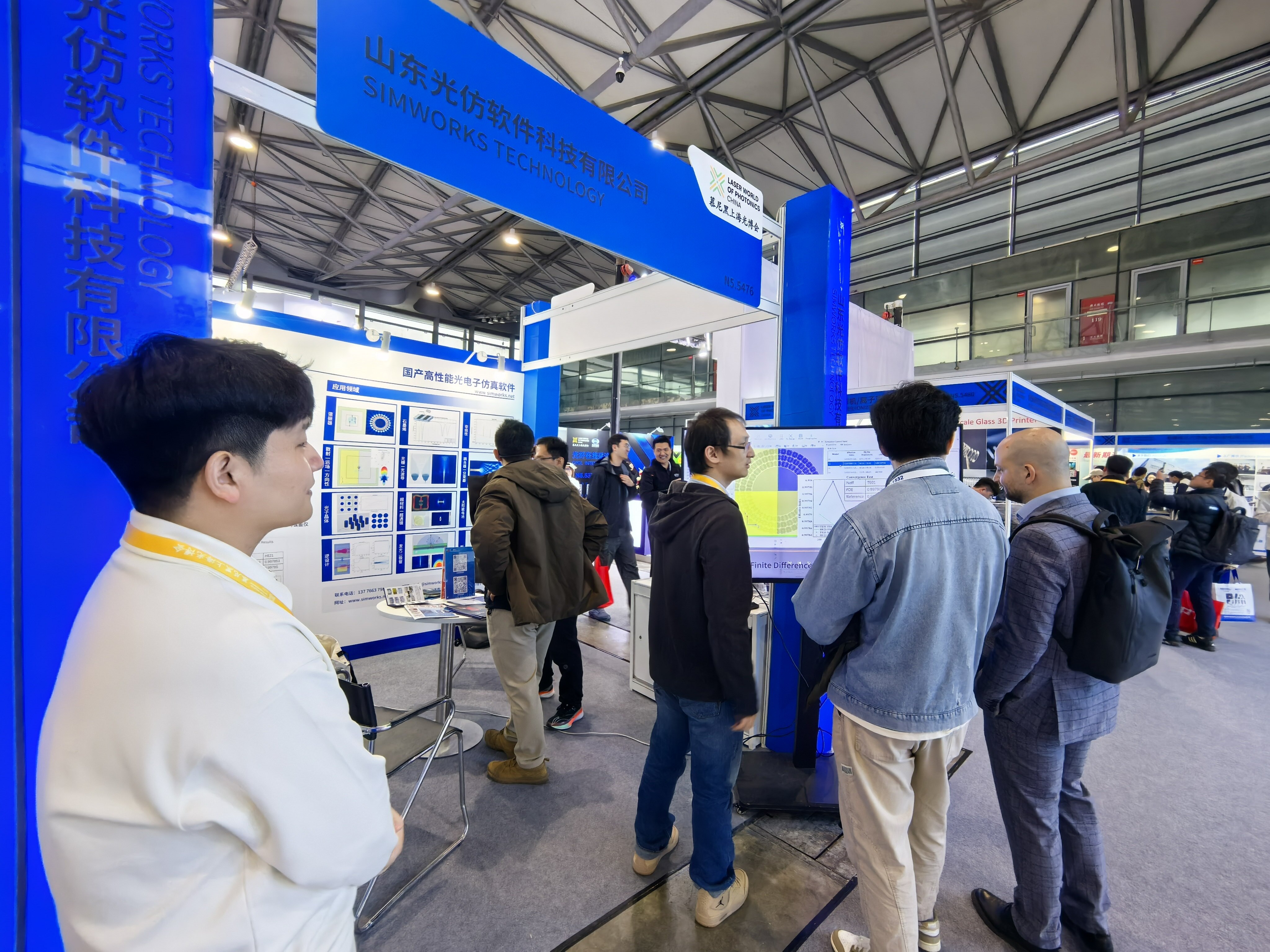
From March 18 to 20, Shandong Guangfang Software showcased its self-developed SimWorks high-performance photonics simulation software at Laser World of Photonics China 2026. During the exhibition, we highlighted SimWorks' advancements in inverse optimization algorithms, GPU acceleration, cloud computing, and application areas. Through live demonstrations and technical presentations, we gained widespread attention and recognition from companies in the optoelectronics industry as well as research institutions and universities. ## Industry Engagement and Collaboration As a domestically developed simulation software, SimWorks attracted significant interest from numerous industry players. Several benchmark organizations, including Huawei, the Shanghai Institute of Optics and Fine Mechanics (Chinese Academy of Sciences), and Zhongke Grating, visited our booth for in-depth discussions on the software's core functionalities and application scenarios, and also made arrangements for future usage. Additionally, our booth welcomed many international industry professionals. These cross-border technical exchanges not only broadened our global perspective but also laid the groundwork for exploring potential opportunities worldwide. ![Description](https://simworksofficial-files.oss-cn-beijing.aliyuncs.com/jpg/3_2026/03/25A009.jpg) ![Description](https://simworksofficial-files.oss-cn-beijing.aliyuncs.com/jpg/5_2026/03/25A010.jpg) ![Description](https://simworksofficial-files.oss-cn-beijing.aliyuncs.com/jpg/6_2026/03/25A011.jpg) ## Interest and Feedback from University Faculty and Students Throughout the exhibition, both new and familiar friends from top-tier universities such as Tsinghua University, Shanghai Jiao Tong University, Huazhong University of Science and Technology, Beijing Institute of Technology, Westlake University, and University of Shanghai for Science and Technology came to our booth. They engaged with the SimWorks technical team to discuss the software's applications and expansion in academic research. There was strong anticipation regarding the progress of domestically developed photonics simulation software and its ability to match international benchmarks. While long-time users shared their SimWorks simulation experiences, many new users were also drawn to try the software on-site, providing us with valuable feedback and suggestions that we will carefully consider for further development and improvement. ![Description](https://simworksofficial-files.oss-cn-beijing.aliyuncs.com/jpg/1_2026/03/25A012.jpg) ![Description](https://simworksofficial-files.oss-cn-beijing.aliyuncs.com/jpg/2_2026/03/25A013.jpg) ![Description](https://simworksofficial-files.oss-cn-beijing.aliyuncs.com/jpg/4_2026/03/25A014.jpg)------------------------------------ ## Exhibition Concludes, Progress Continues Shandong Guangfang Software remains committed to advancing the field of domestically developed photonics simulation, providing reliable, homegrown solutions to serve the industry as a foundational pillar for China's optoelectronics sector. We would like to once again express our gratitude to all colleagues and partners who visited the SimWorks booth during the exhibition. Your support is our greatest motivation to keep moving forward! ### Scan to Follow Our WeChat Service Account ### ![WeChat Service Account QR Code](https://simworksofficial-files.oss-cn-beijing.aliyuncs.com/png/image_2025/08/07A007.png){{{width=200px height=auto}}}
2026-03-21 09:18:39
Details
SimWorks releases SimWorks Finite Difference Solutions version 3.1.0

SimWorks releases SimWorks Finite Difference Solutions version 3.1.0

Dear users: Thank you all for your attention and support to the SimWorks software. To further optimize the user experience and enhance the simulation quality, this software has been updated to version 3.1.0.**The key update contents this time are:** #### Adds the EME Eigenmode Expansion Solver The Eigenmode Expansion (EME) solver divides a long waveguide structure into multiple cells along the propagation direction, solves for the eigenmodes of the cross-section in each cell, and then computes the coupling of these modes between adjacent cells to obtain the complete optical characteristics of the entire device. The EME solver is particularly suitable for analyzing and designing photonic devices with lengths much larger than the wavelength and with slowly varying or periodic refractive index profiles, such as multimode interference couplers (MMIs), fiber Bragg gratings, and adiabatic tapered waveguides. Compared to direct 3D FDTD simulations, the EME solver achieves significantly faster computation speeds while maintaining accuracy, and allows rapid parameter sweeps of key parameters such as device length and wavelength after a single mode calculation, greatly enhancing the design efficiency of photonic integrated circuits. ![](https://simworksofficial-files.oss-cn-beijing.aliyuncs.com/mdfile/resources/img/EME_cell_s_matrix.png) #### Slurm Cluster Resources Now Support File Transfer via Shared Folders and Local Slurm Job Submission This update brings two major enhancements to SimWorks' Slurm cluster resource management: support for file transfer via shared folders, and the ability to submit Slurm jobs directly from a local machine (Linux only). - Support for file transfer via shared folders This feature allows users to map their local working directory to a shared directory on the Slurm cluster. With just one-time path mapping configuration, the system automatically translates local paths to cluster-recognized paths, enabling direct read and write access to project files and result data without the need for traditional SSH+SCP uploads and downloads. This significantly improves file transfer speed and simplifies workflows, especially for handling large datasets. - Local Slurm job submission (Linux only) Now, users on local Linux hosts with Slurm client components installed can choose the local mode to submit Slurm jobs. In this mode, Slurm commands such as `sbatch` are executed directly on the local machine to submit computational tasks, eliminating the need to SSH into a remote management node. This "local submission" mode reduces network hops, making job submission more convenient and efficient, and lowers the risk of job submission failures due to network instability. The local job submission feature is currently supported only on Linux. Users need to configure the job submission method (Local) and file transfer method (Shared directory) in the SimWorks cluster configuration interface, and correctly specify the local-to-remote path mapping. ![](https://simworksofficial-files.oss-cn-beijing.aliyuncs.com/mdfile/resources/img/Slurm_setting_local.png) #### Adds the rectilinear grid dataset type `rectilineardataset` Adds a new rectilinear grid dataset type `rectilineardataset`, providing more flexibility for data storage and processing. Complete update content see - [Release Notes](https://www.simworks.net/en/release-note/-/v3.1), Welcome users to download to use - [Customer Downloads](https://www.simworks.net/en/trial-instruction) ! Shandong Guangfang Software Company has been deeply engaged in the development of optical simulation software for many years, committed to providing more professional and efficient simulation services. Once again, we thank you all for your attention and look forward to your feedback and valuable suggestions!
2026-02-28 17:48:15
Details
SimWorks releases SimWorks Finite Difference Solutions version 3.0.0

SimWorks releases SimWorks Finite Difference Solutions version 3.0.0

Dear users: Thank you all for your attention and support to the SimWorks software. To further optimize the user experience and enhance the simulation quality, this software has been updated to version 3.0.0. **The key update contents this time are:** #### Support for Topology-Based Inverse Design Optimization Inverse design now supports a more flexible topology optimization method. It liberates users from dependence on predefined geometries. By simply specifying a design region and available materials, the algorithm automatically explores the optimal material distribution within that space, ultimately generating high-performance designs with structures that may far exceed traditional expectations. The core concept involves discretizing each FDTD grid cell within the design region into a design parameter representing a material. Based on the normalized grayscale values of these parameters, the topology optimizer is initiated, yielding an optimal design that combines high performance with intricate topology. This provides a powerful tool for developing a new generation of ultra-compact photonic devices, efficient optical sensors, and more. ![](https://simworksofficial-files.oss-cn-beijing.aliyuncs.com/mdfile/resources/img/topology_optimization_new.png) #### Support for MATLAB API Calls The software provides MATLAB API functionality, allowing users to deeply interact with the SimWorks Finite Difference Solutions simulation software by writing MATLAB scripts or programs. Through this interface, users can: - Directly control the simulation software: perform operations such as launching the software, setting parameters, and running simulations. - Achieve bidirectional data exchange: transmit variables, matrices, and complex data structures from the MATLAB workspace to SimWorks, and also extract simulation results and data from the software. - Build automated workflows: integrate the simulation setup, execution, and post-processing flow within the MATLAB environment to achieve task batching, parameter sweeps, and design optimization. Leveraging this API, users can seamlessly combine the powerful physical field simulation capabilities of SimWorks with MATLAB's data analysis and visualization functions. This not only significantly improves the efficiency of simulation post-processing but also offers high flexibility for realizing more complex modeling and building customized simulation platforms. The following code sets up the API runtime environment for SimWorks FD Solutions in MATLAB. ```matlab % Setting up the MATLAB API environment for SimWorks Finite Difference Solutions % Set the software file path (the directory containing `fd_solution.exe`) bin_dir = 'C:\Program Files\SimWorks\SimWorks FD Solutions\bin'; if ~contains(getenv('PATH'), bin_dir) setenv('PATH', [getenv('PATH') ';' bin_dir]); end % Set the MATLAB API interface file path (the directory containing `.mexw64` files) mex_dir = 'C:\Program Files\SimWorks\SimWorks FD Solutions\api\matlab'; if ~contains(path, mex_dir) path(path, mex_dir); end ``` #### New Planar Solid Structure Support is added for the *Planar Solid* structure, which resembles a polygon structure extruded into three-dimensional space. Users can directly construct solid models of arbitrary shapes by defining vertices and facets. This fundamentally simplifies the creation process for complex 3D components. Users no longer need to manually combine multiple basic structures (like blocks and cylinders) and tediously set the mesh order for their overlapping parts, thereby significantly improving modeling efficiency and accuracy. Using this structure requires defining two key variables: - _vertices_: A vertex coordinate matrix, where each row represents the (x, y, z) coordinates of a vertex. - _facets_: Defines which vertices enclose each facet. This variable can be a matrix or a cell array. The order of vertex indices should follow the right-hand rule to determine the front and back sides of a facet (as shown in the figure below, the path defined by vertices $1 \rightarrow 2 \rightarrow 3 \rightarrow 4$ represents the front side, while the path $5 \rightarrow 6 \rightarrow 7 \rightarrow 8$ represents the back side). ![](https://simworksofficial-files.oss-cn-beijing.aliyuncs.com/mdfile/resources/img/planar_solid_picture.png) Complete update content see - [Release Notes](https://www.simworks.net/en/release-note/-/v3.0), Welcome users to download to use - [Customer Downloads](https://www.simworks.net/en/trial-instruction) ! Shandong Guangfang Software Company has been deeply engaged in the development of optical simulation software for many years, committed to providing more professional and efficient simulation services. Once again, we thank you all for your attention and look forward to your feedback and valuable suggestions!
2026-01-30 17:31:26
Details