

SimWorks releases SimWorks Finite Difference Solutions version 3.7.0
Dear users:
Thank you all for your attention and support to the SimWorks software. To further optimize the user experience and enhance the simulation quality, this software has been updated to version 3.7.0. The key update contents this time are:
RCWA Solver Enhancements
This update further improves the RCWA solver with enhancements in field distribution monitoring and propagation direction settings, expanding the analysis scope and modeling flexibility for periodic structure simulations—applicable to gratings, waveguide gratings, metasurfaces, and multilayer periodic structures. Key updates include:
- New RCWA Field Monitor Supports viewing the frequency-domain field distribution at arbitrary locations within the simulation region. Users can add Field Monitor objects in an RCWA project, specify the monitoring location and frequency range, and obtain the electric field, magnetic field, and other frequency-domain responses at that point for analyzing field distributions, resonant modes, and local field enhancement inside periodic structures. This extends RCWA analysis beyond global optical responses (reflectance, transmittance, diffraction efficiency, etc.) to spatial field distributions, facilitating cross-validation against FDTD results; see the figure below for an example.
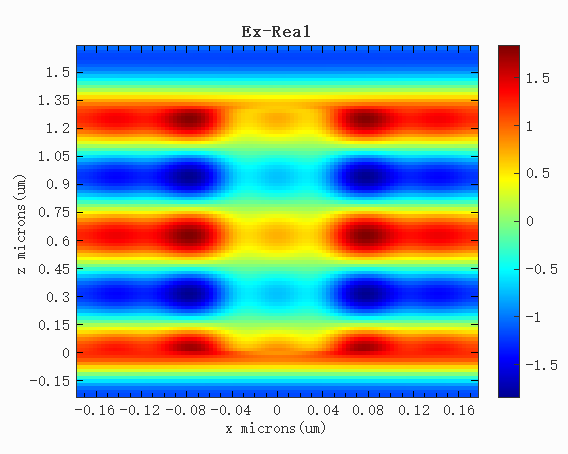
- New backward and both propagation directions The backward mode is suitable for analyzing incidence from the rear side of the structure; the both mode computes both forward and backward propagation responses simultaneously, facilitating comparative studies of symmetric structures or bidirectionally coupled devices.
New stackdipole and stackpurcell Script Commands in the Stack Series
The Stack script series adds two new commands, stackdipole and stackpurcell, extending the analytical computation capabilities for planar multilayer film structures beyond stackrt and stackfield:
stackdipole: Computes the radiation properties of an electric dipole embedded in a multilayer film stack, including radiated power and directivity, for analyzing dipole emission in microcavities, waveguides, and thin-film devices.stackpurcell: Computes the Purcell factor (spontaneous emission rate enhancement factor) for a dipole in a multilayer environment, for evaluating how surrounding structures modulate emission rates—relevant to metal/dielectric interfaces, microcavities, OLEDs, and related devices.
These commands follow the same transfer matrix method (TMM) approach as the existing Stack series: fast analytical computation without mesh generation, well suited to parameter sweeps and optimization. They are applicable to quantum optics, microcavity emission, Purcell effect studies, and near-field coupling research and design.
2.5D Mesh Generation Performance Optimization
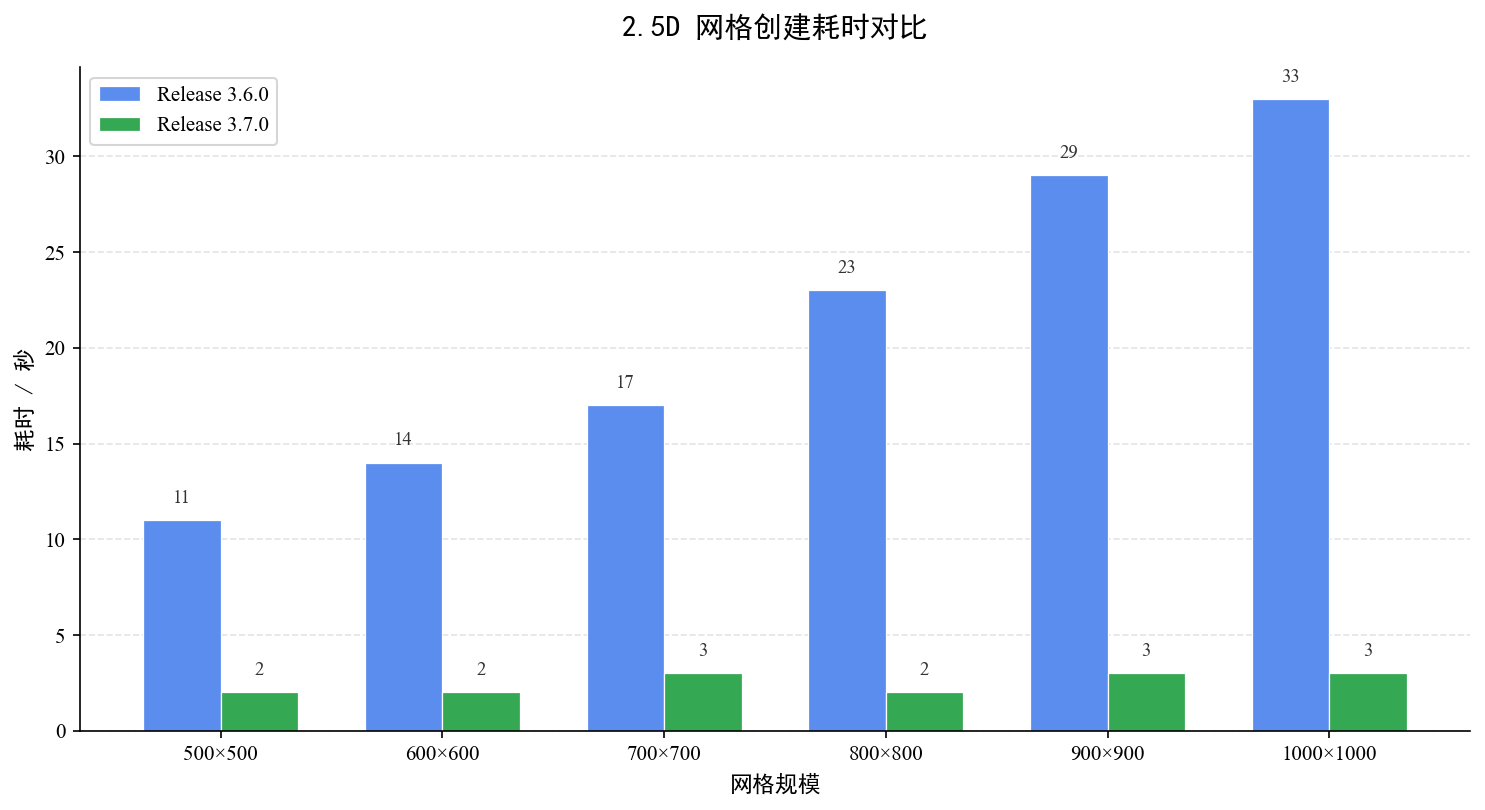
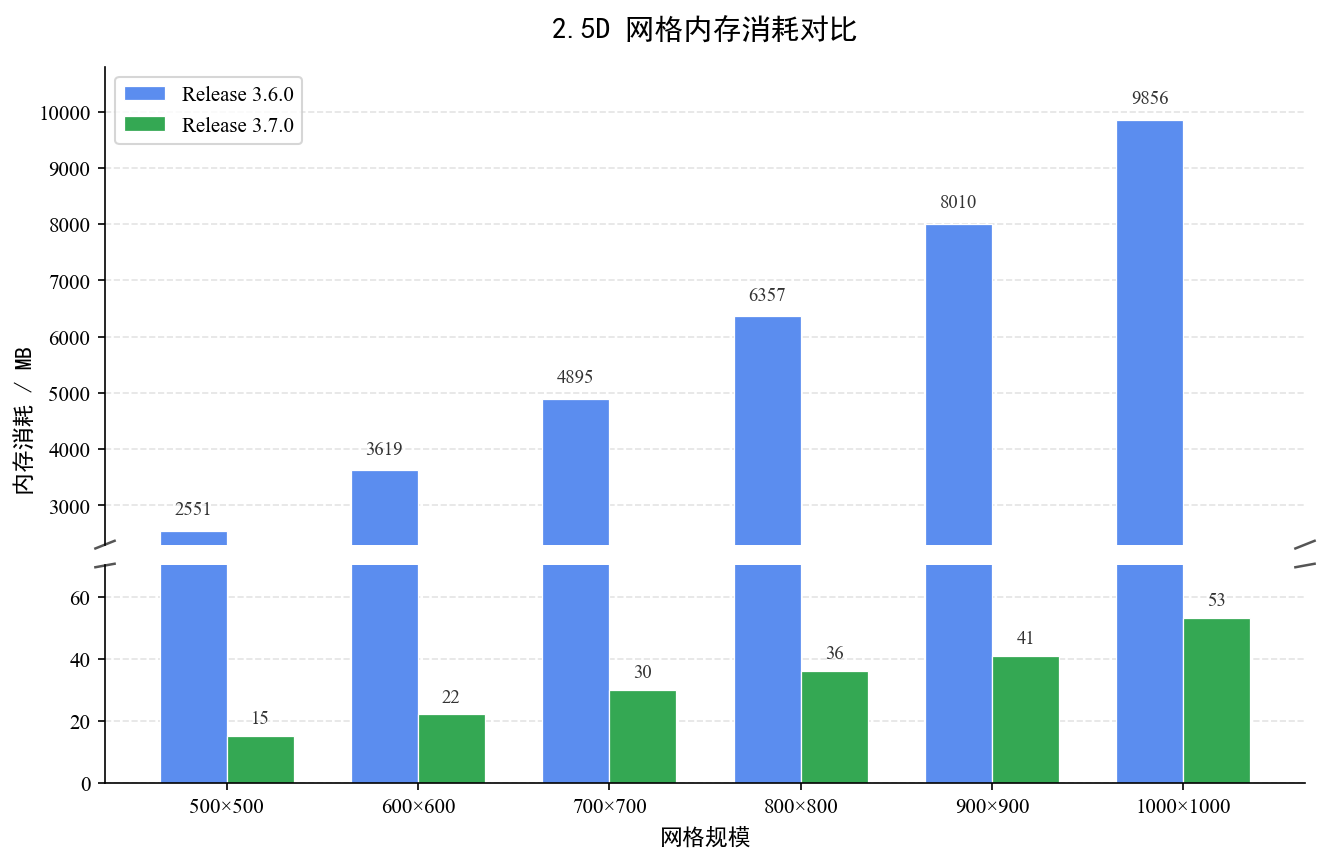
This update significantly optimizes 2.5D mesh generation speed and reduces memory consumption, accelerating mesh building and subsequent simulation preparation for large-scale 2.5D projects. In tests from 500 500 to 1000 1000 mesh sizes, Release 3.7.0 compared with Release 3.6.0 achieves an overall 5–10 improvement in mesh creation; average memory usage drops by over 99%. See the figures below for details.
Complete update content see - Release Notes, Welcome users to download to use - Customer Downloads !
Shandong Guangfang Software Company has been deeply engaged in the development of optical simulation software for many years, committed to providing more professional and efficient simulation services. Once again, we thank you all for your attention and look forward to your feedback and valuable suggestions!