

SimWorks releases SimWorks Finite Difference Solutions version 3.5.0
Dear users:
Thank you all for your attention and support to the SimWorks software. To further optimize the user experience and enhance the simulation quality, this software has been updated to version 3.5.0. The key update contents this time are:
New stack Script Commands: Rapid Calculation of Optical Response for Planar Multilayer Film Stacks
The new stack script commands provide fast analytical computation of the optical response of one-dimensional multilayer film structures based on the transfer matrix method (TMM). For dielectric structures that are laterally uniform and only layered along the thickness direction, this method assigns a transfer matrix to each layer, obtains the overall transfer matrix through matrix multiplication, and finally solves for reflectance, transmittance, and field distribution.
This series currently includes the following two script commands:
stackrt: Calculates reflectance and transmittance under plane-wave incidence, returning power ratios and coefficients for S/P polarization.stackfield: Computes the electric and magnetic field distribution inside the multilayer structure, supporting analysis of standing-wave patterns, absorption profiles, and field enhancement effects.
Users only need to input the refractive index, thickness, frequency, and incidence angle of each layer to obtain results quickly. This command series is suitable for rapid preliminary evaluation in scenarios such as film design, VCSELs, OLEDs, and Bragg grating mirrors.
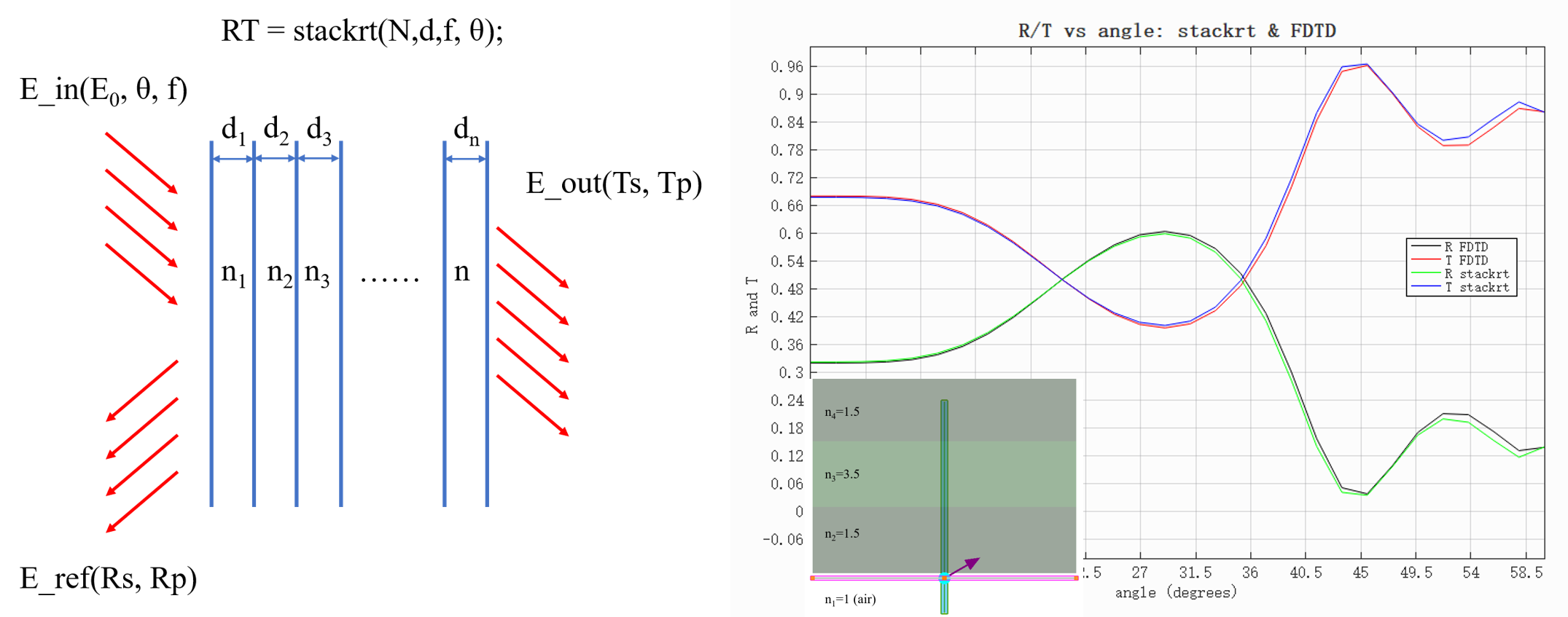
The stack script functions offer significant advantages including high computation speed, no need for mesh generation, and high numerical accuracy, making them especially suitable for parameter sweeps and optimization iterations. The following figure shows the schematic principle and validation of calculation results for stackrt:
New Assembly Group Feature
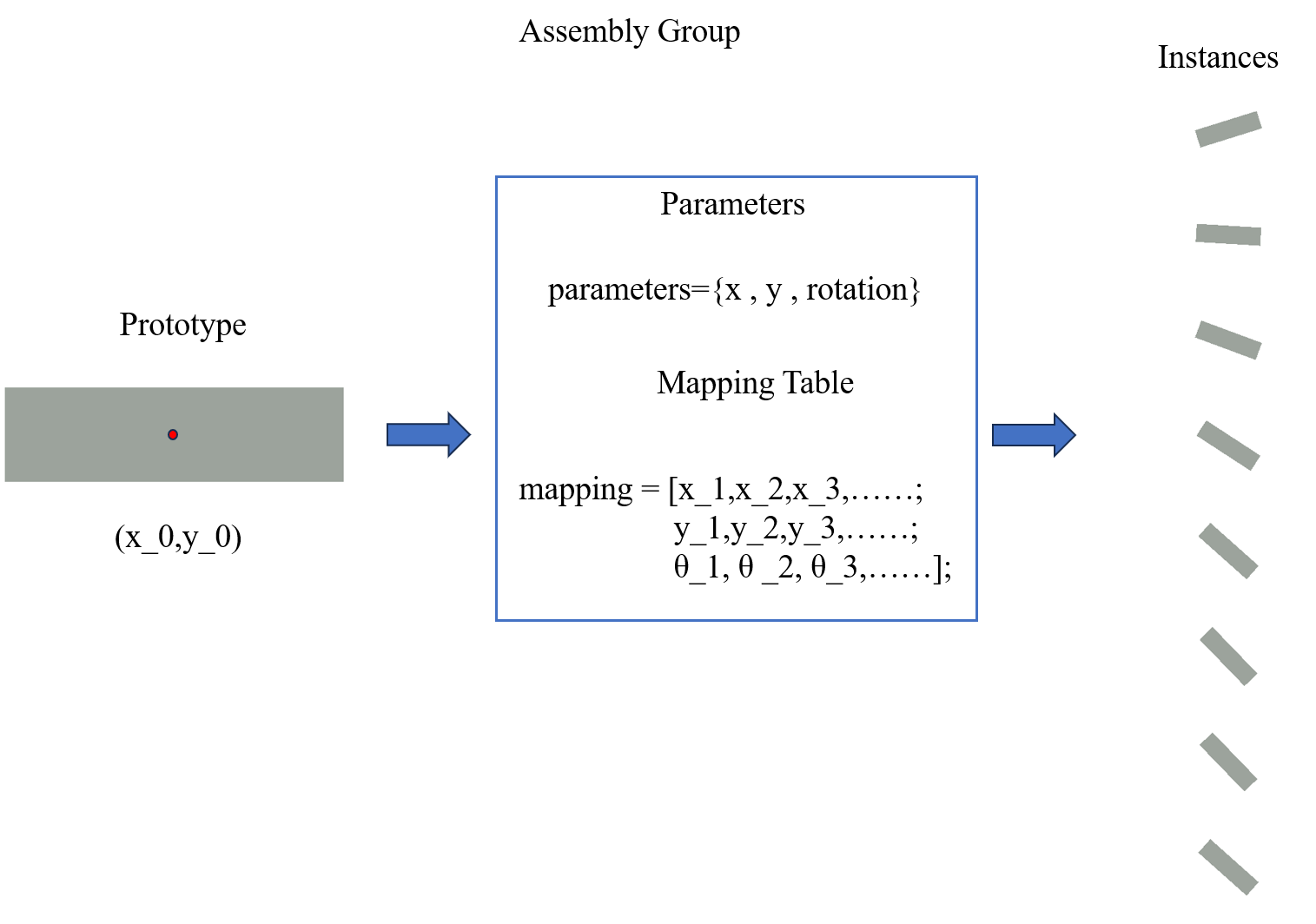
The Assembly Group is a special group type designed for efficiently creating complex structures composed of a large number of repeated or similar objects, such as metalens arrays. Its core concept is "define once, reuse multiple times"—by using a prototype object and a parameter mapping table, users can generate multiple instances in batch, significantly improving geometric construction and mesh generation speed.
This feature is fully driven by scripts (supporting commands such as addassemblygroup, addtogroup, setnamed), and includes a built-in variant management mechanism (rotation and translation are treated as free variables and do not consume variant slots), greatly simplifying the design and simulation workflow for large-scale periodic or quasi-periodic structures.
New Conformal Variant CP‑EP0 Conformal Mesh Method
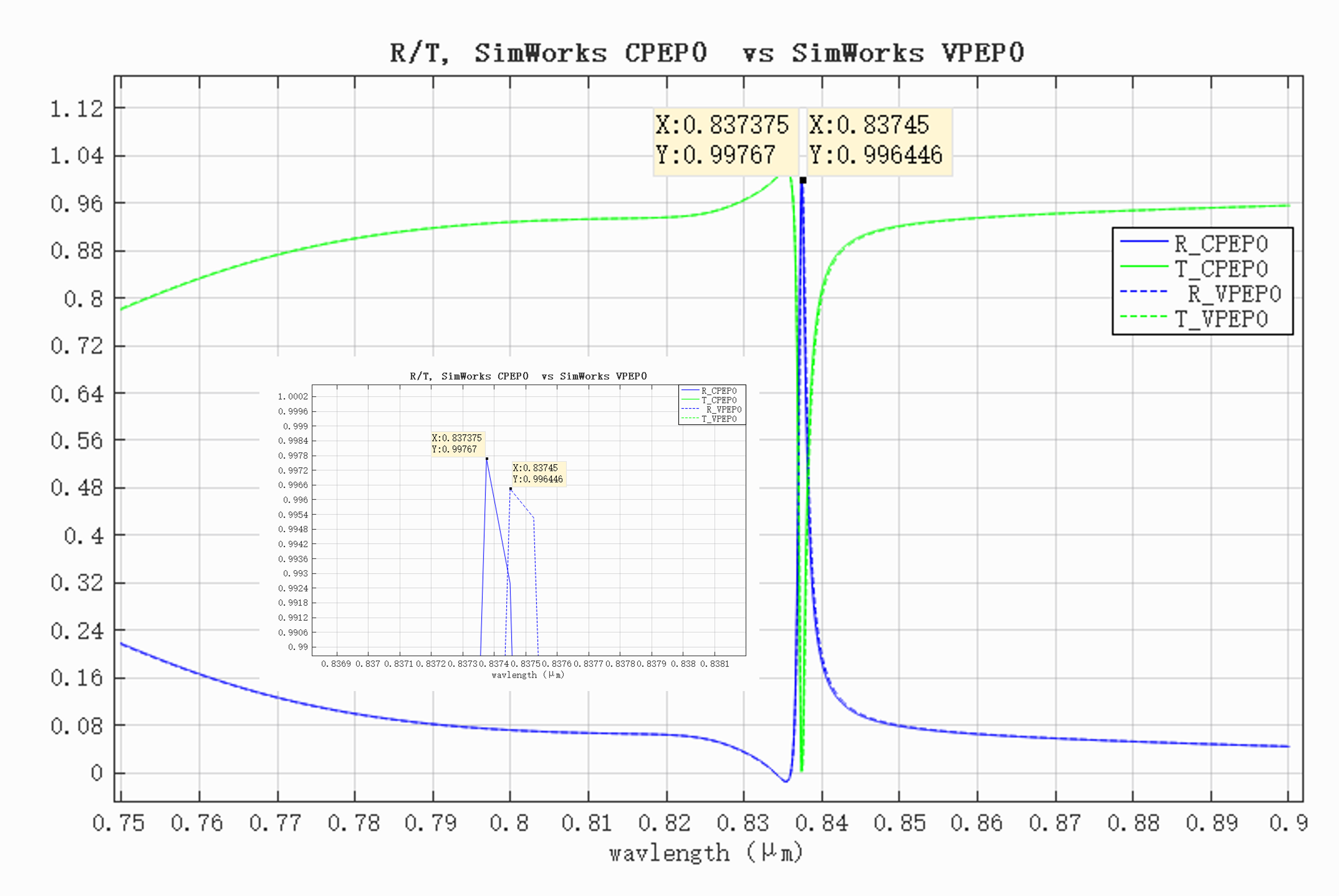
CP‑EP0 (Contour Path Effective Permittivity 0) is a high‑accuracy conformal mesh technique for dielectric interfaces. For interface segments within a mesh cell, it weights contributions along the wave propagation direction (e.g., z‑axis) by length ratio and on the cross‑sectional plane (e.g., xy‑plane) by area ratio, thereby computing the equivalent permittivity of each cell accurately.
This method can precisely capture curved interfaces of three‑dimensional complex structures even with a coarse mesh, significantly reducing meshing difficulty and memory consumption. For dielectric optoelectronic devices with curved boundaries—such as microlenses, waveguide couplers, and curved multilayer films—CP‑EP0 describes the interface refractive index distribution more accurately and faster than traditional volume‑averaged (V‑EP) and polarization‑dependent (VP‑EP) methods, making it an ideal choice for such scenarios.
Custom Time Signals for Light Sources via Script
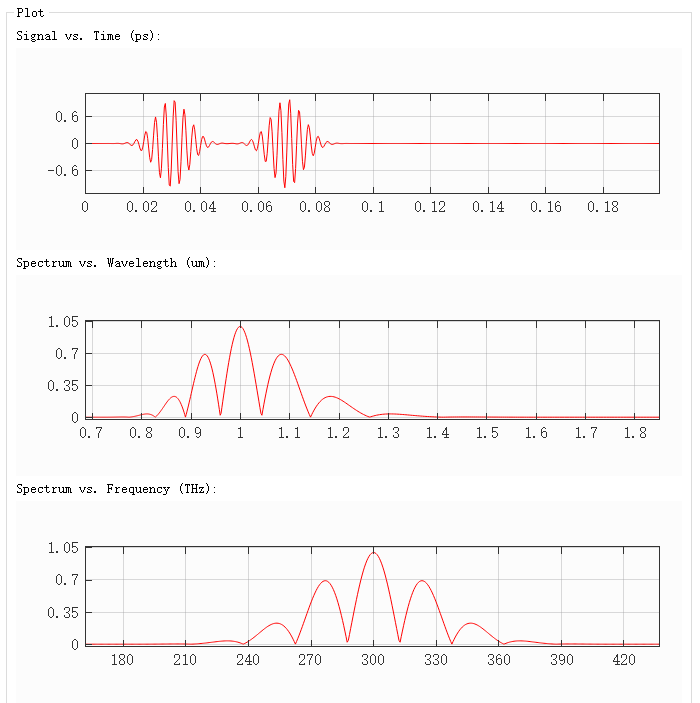
The new setsourcesignal script command allows users to specify a custom time‑domain pulse waveform for an existing light source in the solver. This command does not create a new source; it only modifies the time‑domain signal of the existing source while preserving its geometry, position, and other physical attributes, thus offering flexible waveform replacement on top of the current source.
This feature is mainly targeted at applications requiring precise control of pulse temporal shapes, such as nonlinear optical simulations. Users can define amplitude and phase based on arbitrary time sequences, enabling non‑standard injection waveforms like double pulses, chirped pulses, rectangular pulses, or arbitrary modulated waveforms, providing greater flexibility for research that requires custom pulse shapes.
 Complete update content see - Release Notes, Welcome users to download to use - Customer Downloads !
Shandong Guangfang Software Company has been deeply engaged in the development of optical simulation software for many years, committed to providing more professional and efficient simulation services. Once again, we thank you all for your attention and look forward to your feedback and valuable suggestions!