

SimWorks releases SimWorks Finite Difference Solutions version 3.6.0
Dear users:
Thank you all for your attention and support to the SimWorks software. To further optimize the user experience and enhance the simulation quality, this software has been updated to version 3.6.0. The key update contents this time are:
New RCWA Solver and Corresponding Script Capabilities
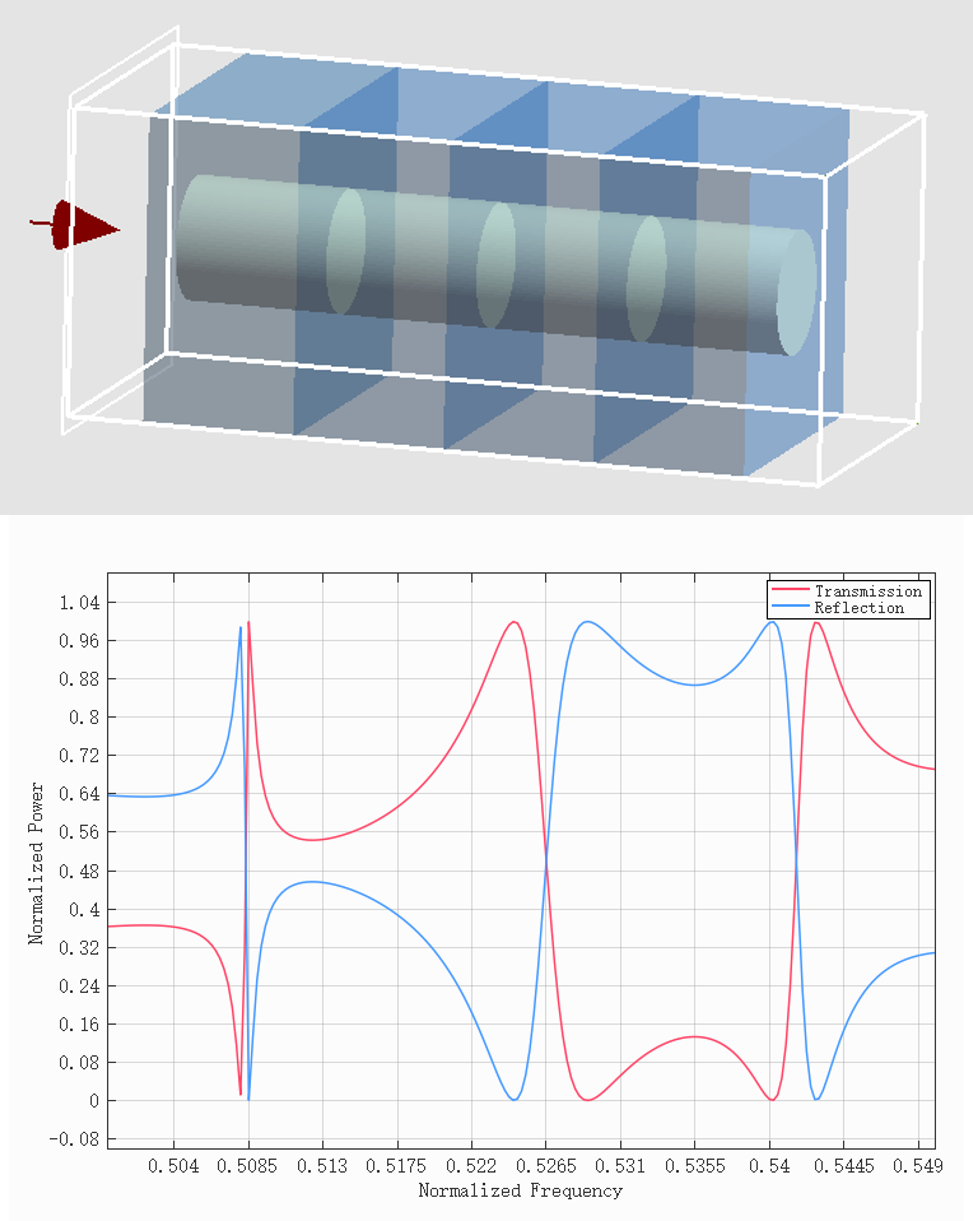
The new RCWA solver is a semi-analytical simulation tool for analyzing the optical response of multilayer structures with periodic variations along the propagation direction under plane-wave incidence. It can compute reflectance, transmittance, and diffraction efficiency.
The RCWA solver is especially suitable for analyzing and designing periodic subwavelength structures such as diffraction gratings, metasurfaces, photonic crystal slabs, and waveguide gratings. Its core principle is to solve Maxwell's equations analytically in the Fourier domain for each layer, using the number of K vectors (i.e., Fourier-mode wave vectors) to balance simulation accuracy and speed. Increasing the number of K vectors improves accuracy; for structures with complex boundaries or high refractive-index contrast, it is recommended to increase the number and perform convergence testing. Once sufficiently converged, the RCWA results are highly consistent with FDTD.
In terms of scripting support, the new addrcwa command is used to create an RCWA solver, and the run script has also been extended to support RCWA solving tasks. This allows users to seamlessly integrate RCWA models into existing scripted parameter sweeps and batch automated simulation workflows, further improving design and optimization efficiency.
New Support for Diagonal Anisotropic Materials in Stack Script Functions
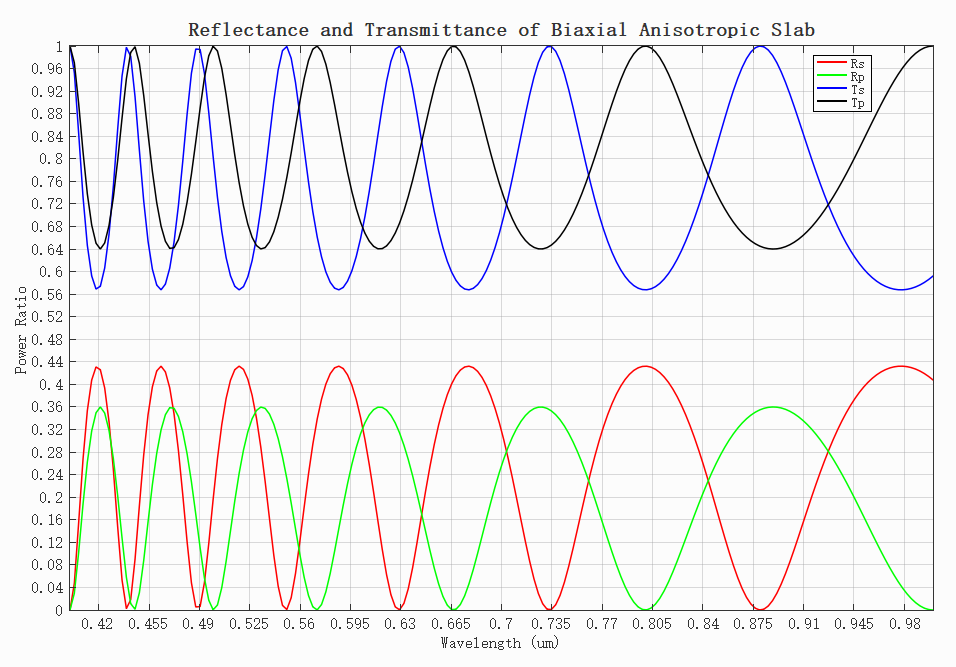
This update extends the calculation capabilities of stackrt and stackfield for diagonal anisotropic (including birefringent) materials:
stackrtsupports both uniaxial and biaxial anisotropic layers. For uniaxial materials with the optical axis along the z direction (nx = ny), the three principal refractive indices [nx, ny, nz] can be specified directly. For more complex biaxial materials (nx ≠ ny), a full refractive-index tensor in diagonal form (with zero off-diagonal elements) must be provided. Both input methods support dispersive materials, allowing the refractive index to be specified independently at each frequency point. The corresponding output results additionally include cross-polarization components.stackfieldsupports the field distribution in uniaxial anisotropic media: it now supports uniaxial materials with the optical axis along the z direction (nx = ny), allowing the electric and magnetic field distributions inside anisotropic layers to be computed.
These updates make the Stack script functions more accurate for simulating diagonal anisotropic thin-film structures such as liquid crystals and crystals, expanding their application scenarios in polarization optics and birefringent device design.
Conformal Mesh Refinement Method Optimization
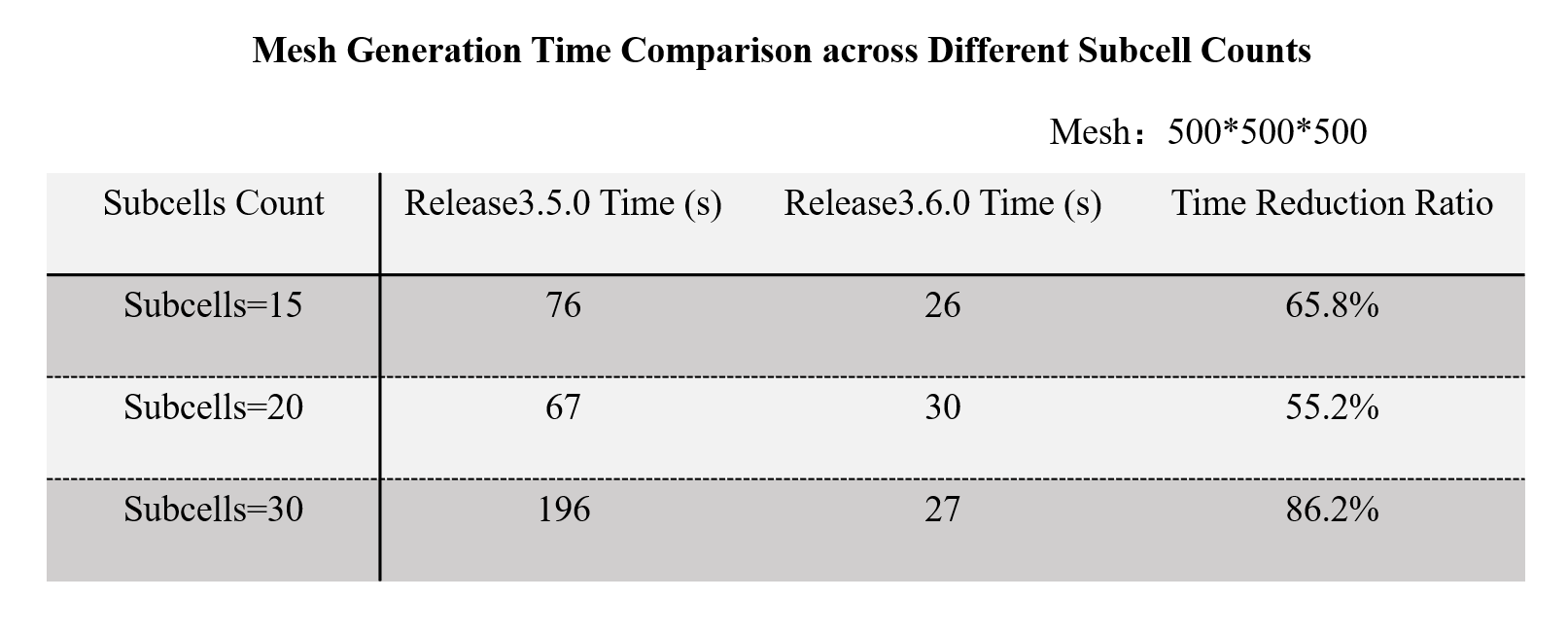
This update optimizes the conformal mesh refinement method, improving accuracy while significantly accelerating mesh generation speed. The method performs precise equivalent material parameter calculations for subgrid cells (subcells), and is particularly suitable for meshing at multi-material interfaces. It effectively reduces meshing difficulty and computational resource consumption while maintaining or improving simulation accuracy. If simulation results appear anomalous, you can uncheck the use geometric volume fraction method for mesh conformal option to revert to the traditional conformal mesh refinement approach.
Complete update content see - Release Notes, Welcome users to download to use - Customer Downloads !
Shandong Guangfang Software Company has been deeply engaged in the development of optical simulation software for many years, committed to providing more professional and efficient simulation services. Once again, we thank you all for your attention and look forward to your feedback and valuable suggestions!