

SimWorks Cloud Computing Solutions
As micro-nano optoelectronic structures evolve towards three-dimensionality and complexity, traditional simulation modes based on standalone workstations are facing severe challenges, including computational power bottlenecks, high hardware maintenance costs, and low efficiency in large-scale parameter scanning.
SimWorks Cloud Computing is a cloud-based high-performance computing solution specifically designed for the optoelectronic design field. By integrating industry-leading cloud computing architectures and parallel computing technologies, SimWorks provides users with a seamless transition from "local design" to "cloud-based simulation," helping researchers and engineers overcome hardware limitations and significantly shorten the design cycle.
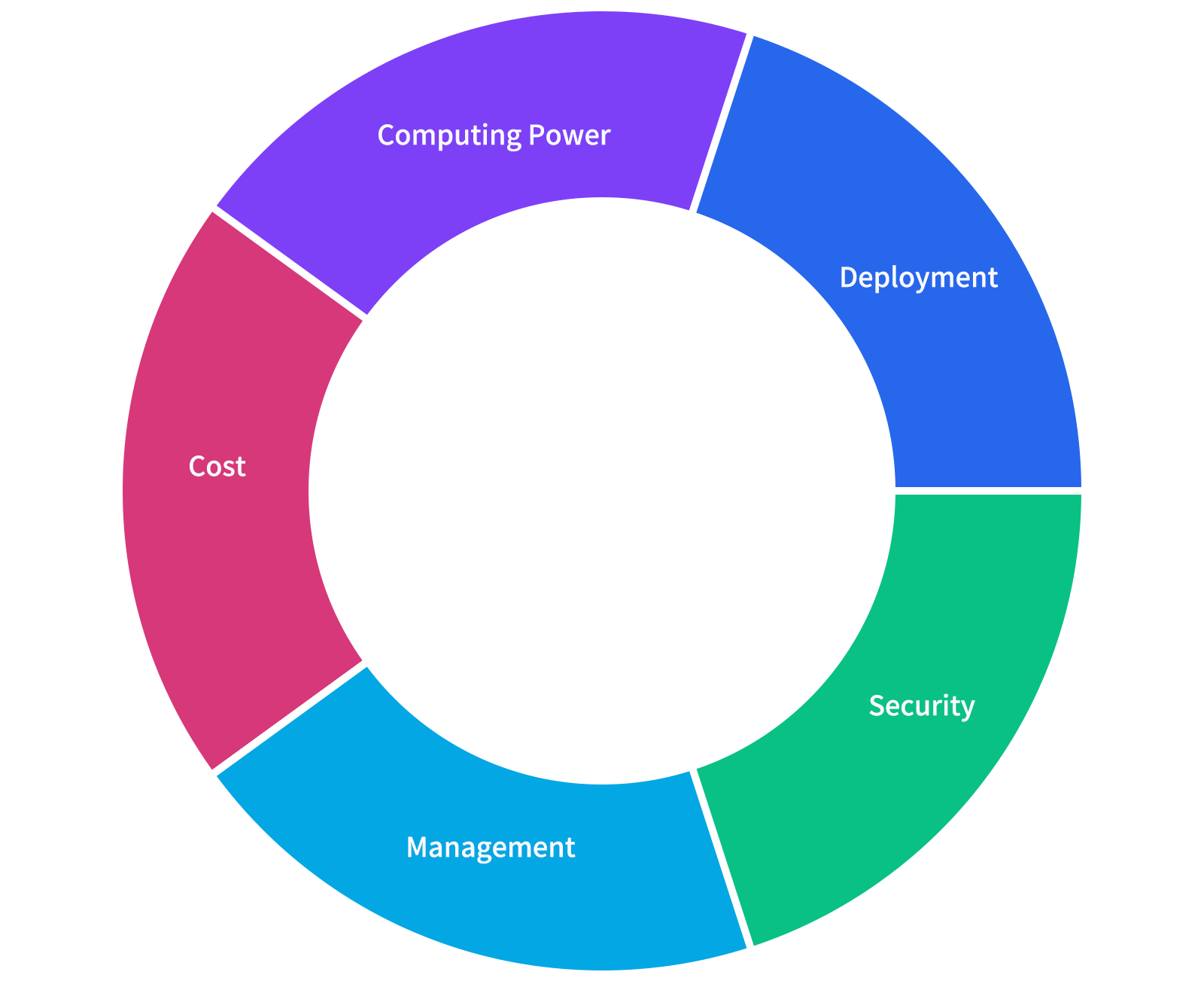
Core Values
- Computational Power Leap, Zero Hardware Burden:
Break the limitations of local workstation hardware performance. There is no need to purchase expensive server clusters; users can call upon large-scale CPU/GPU computing power with a single click, achieving computational performance far exceeding local hardware at a minimal cost. - Ready-to-use, Minimalist Deployment:
No complex environment setup or server maintenance required. Simply install the SimWorks Cloud Computing client locally and connect to the internet to immediately access the cloud high-performance computing environment, enabling "lightweight operation with heavy-duty computation." - Pay-as-you-go, Ultimate Cost-effectiveness:
Utilize a flexible elastic billing model. For "low-frequency, high-computing" simulation jobs, the pay-as-you-go model significantly reduces R&D costs and maximizes the return on investment. - Intelligent Management, Full Scenario Coverage:
Provides a powerful cloud computing console. Individual users can efficiently manage simulation jobs and personal assets, while enterprise-level private cloud users can achieve centralized control over multiple accounts, large-scale computing clusters, and unified simulation storage across the organization. - Ensuring Data Security:
Provides an enterprise-grade security protection system, ensuring the absolute privacy and compliance of core design data throughout its entire lifecycle.
Product Architecture
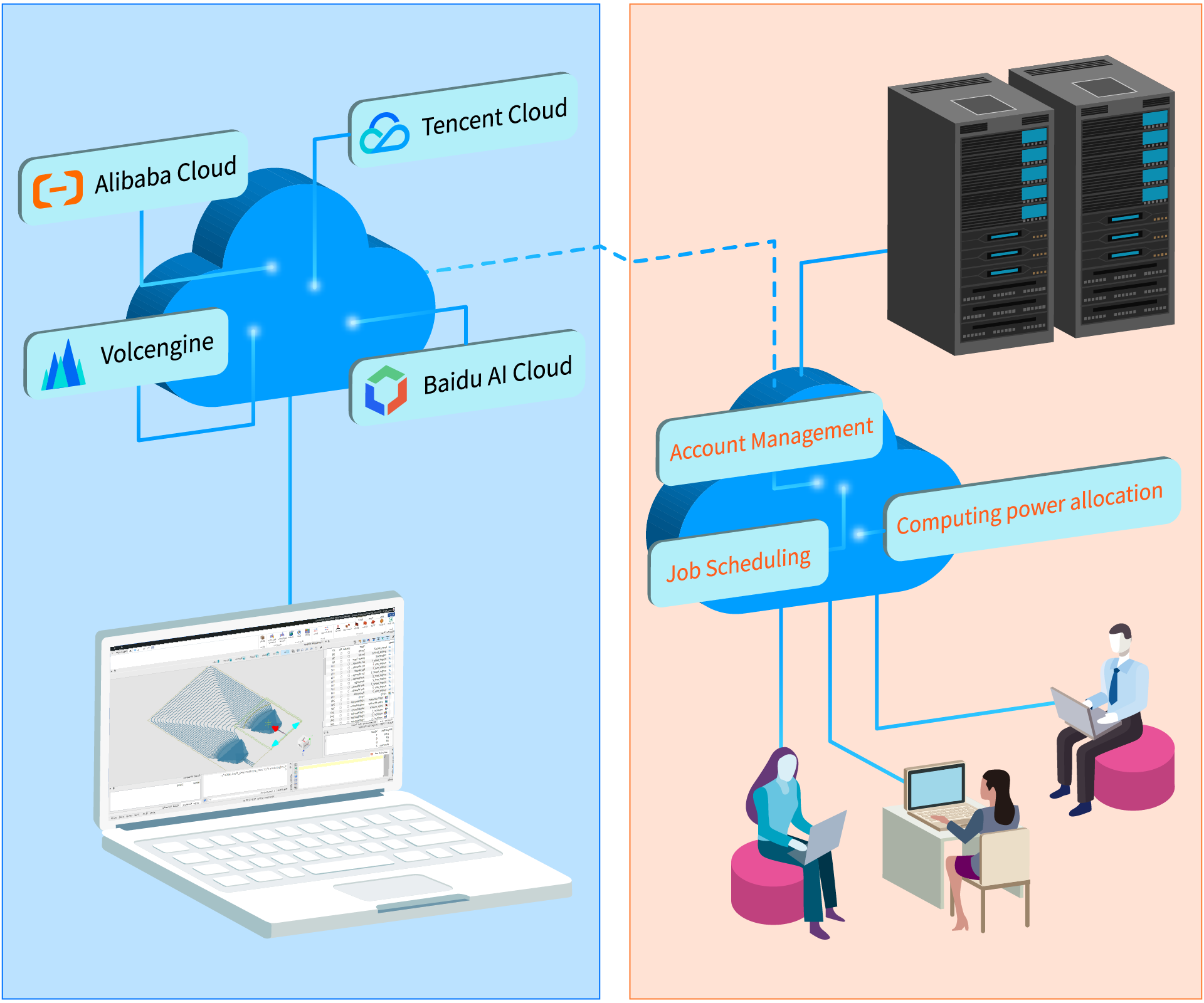
SimWorks Cloud Computing builds a full-link closed-loop architecture from the user interaction terminal to the high-performance computing bottom layer, ensuring the efficient workflow of simulation jobs:
- Software Client:
As the user's core interaction entry point, the SimWorks Cloud Computing client supports remote initiation of simulation jobs, real-time monitoring of simulation progress, and management of the simulation process. - Cloud Computing Console:
The central management system of the platform. Enterprise-level private cloud users possess capabilities for global resource management, account system maintenance, job monitoring, and object storage management; individual users are provided with personal account management and submission/query capabilities for simulation jobs. - High-Performance Computing Clusters
Provides multi-tiered resource support.- Cloud Provider Computing Clusters: SimWorks enables direct integration with mainstream cloud provider APIs (such as Alibaba Cloud, Tencent Cloud, Volcengine, and Baidu AI Cloud) to achieve elastic resource orchestration for simulation jobs.
- Private Computing Clusters: Supports High-Performance Computing (HPC) clusters deployed by either SimWorks or the customer, with Slurm as the default job scheduler.
- Cloud Data Storage
Provides highly reliable engineering file management capabilities.- Public Cloud Object Storage Integration: Supports integration with mainstream public cloud object storage services (such as Alibaba Cloud OSS, Tencent Cloud COS, Baidu AI Cloud BOS, and Volcengine TOS) to provide stable, reliable and persistent storage capability for simulation data.
- Private Object Storage: Supports private deployment via object storage servers such as MinIO, meeting stringent requirements for simulation data security and compliance.
Standard Workflow
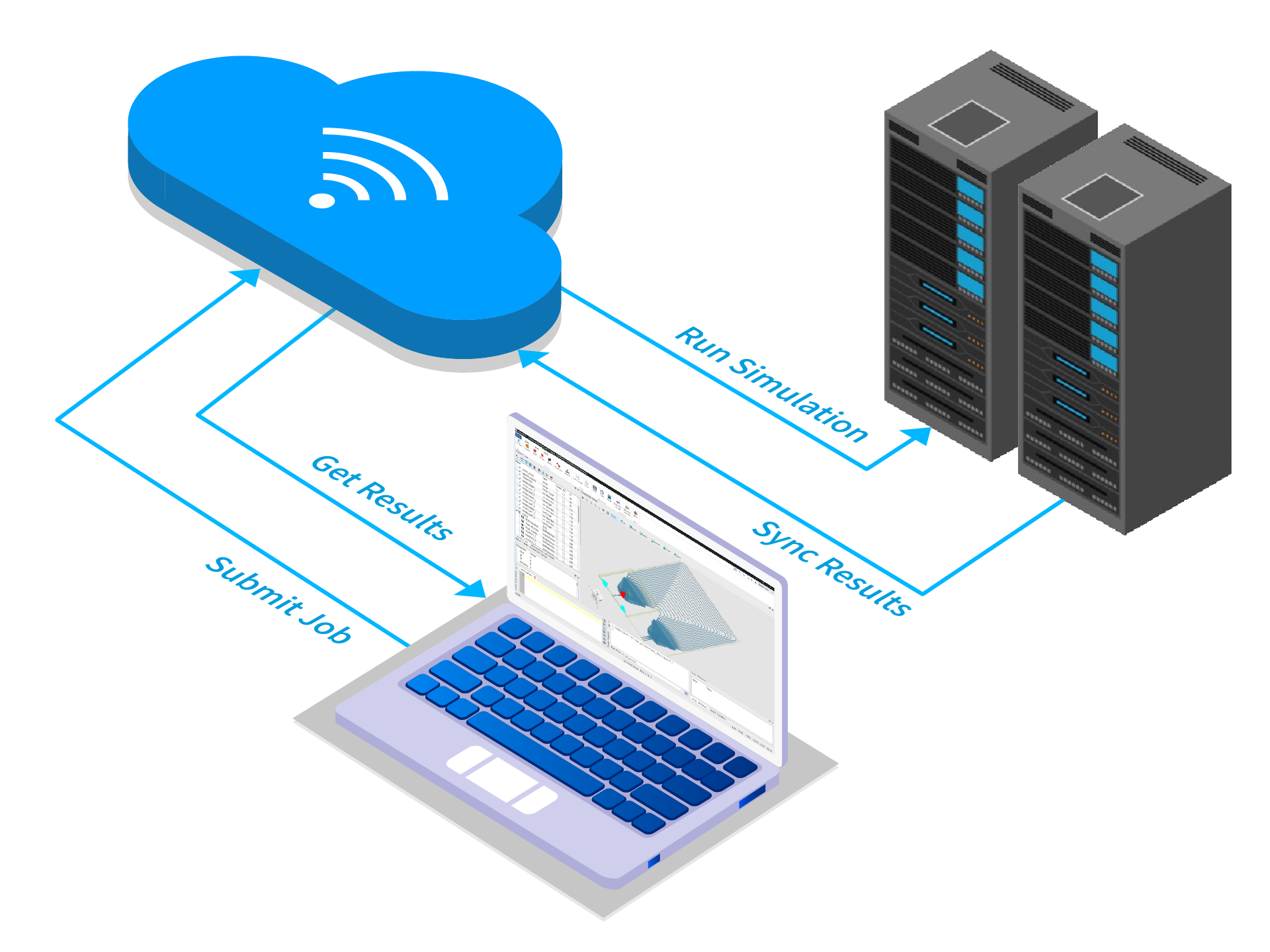
Users select the appropriate computing resources and submit job requests via the SimWorks cloud client. Upon receiving the request, the SimWorks Workbench server dispatches the job to the selected computing cluster for execution. During the process, the Workbench server synchronizes the real-time operational status of the computing nodes (such as progress and logs) to the client, ensuring users can monitor the computation dynamics in real time. Once the simulation is complete, the system automatically uploads the generated simulation project files (including result data) to the preset cloud storage, allowing users to search for and download them directly via the client.
sequenceDiagram
    title SimWorks Simulation Job Full Process
    participant Software Client
    participant Cloud Console as SimWorks Workbench
    participant Computing Cluster
    participant Cloud Storage
    Software Client->>Cloud Console: Initiate Simulation Task (Submit project files/parameters)
    Cloud Console->>Computing Cluster: Allocate simulation computing task
    activate Computing Cluster
    Computing Cluster->>Computing Cluster: Start simulation computing
    loop During Simulation
        Computing Cluster-->>Cloud Console: Report simulation status (Progress/Logs)
        Cloud Console-->>Software Client: Forward simulation status
        Software Client-->>Cloud Console: Send user commands (Pause/Terminate/Adjust)
        Cloud Console-->>Computing Cluster: Forward user commands
    end
    Computing Cluster-->>Cloud Console: Simulation complete, return task status
    Computing Cluster->>Cloud Storage: Upload simulation project files and result data
    Cloud Console-->>Software Client: Notify simulation end, provide download link
    Software Client->>Cloud Storage: Download simulation project files
    deactivate Computing Cluster
Key Features & Technical Advantages
1. High-Performance Parallel Computing Architecture
SimWorks deeply integrates modern high-performance computing technologies to ensure simulation efficiency reaches industry-leading levels:
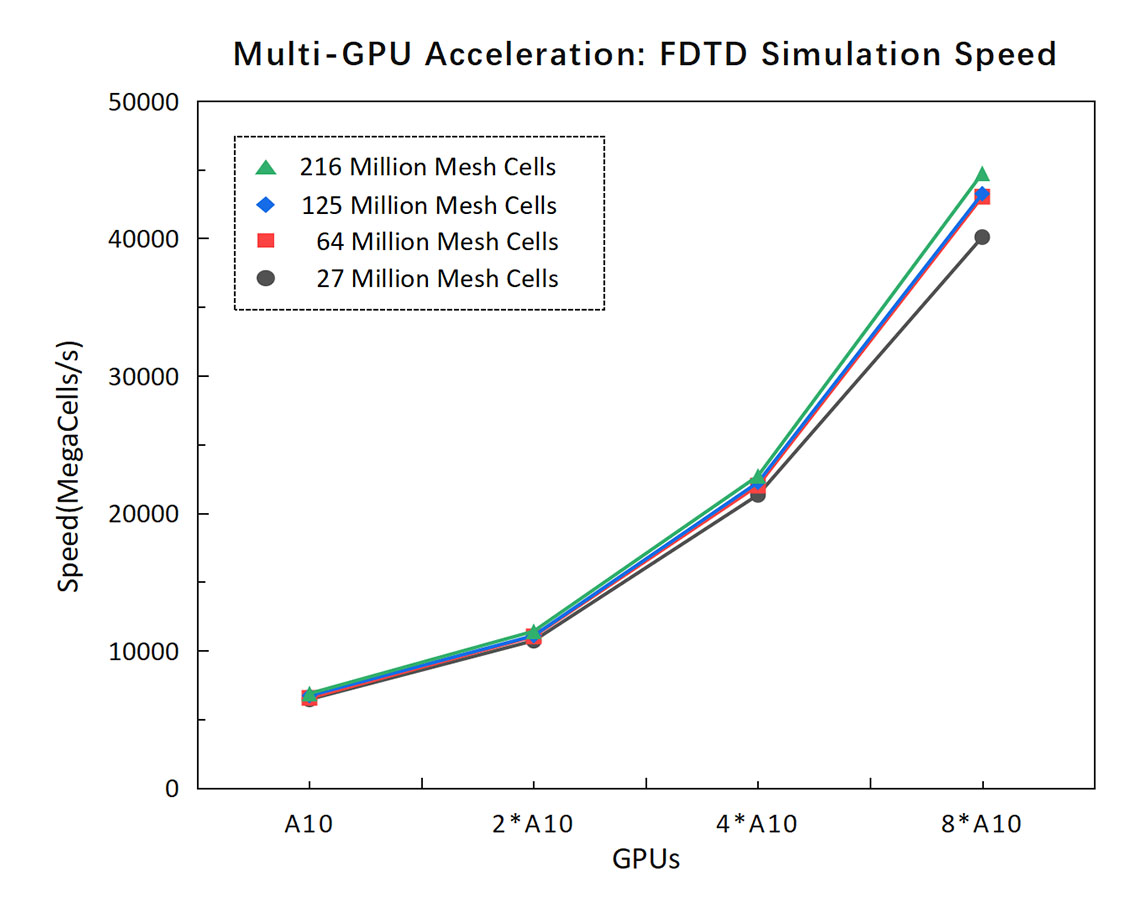
- Multi-dimensional Parallel Support: Perfectly adapts to various parallel computing technologies including OpenMP, CUDA, MPI, and AVX.
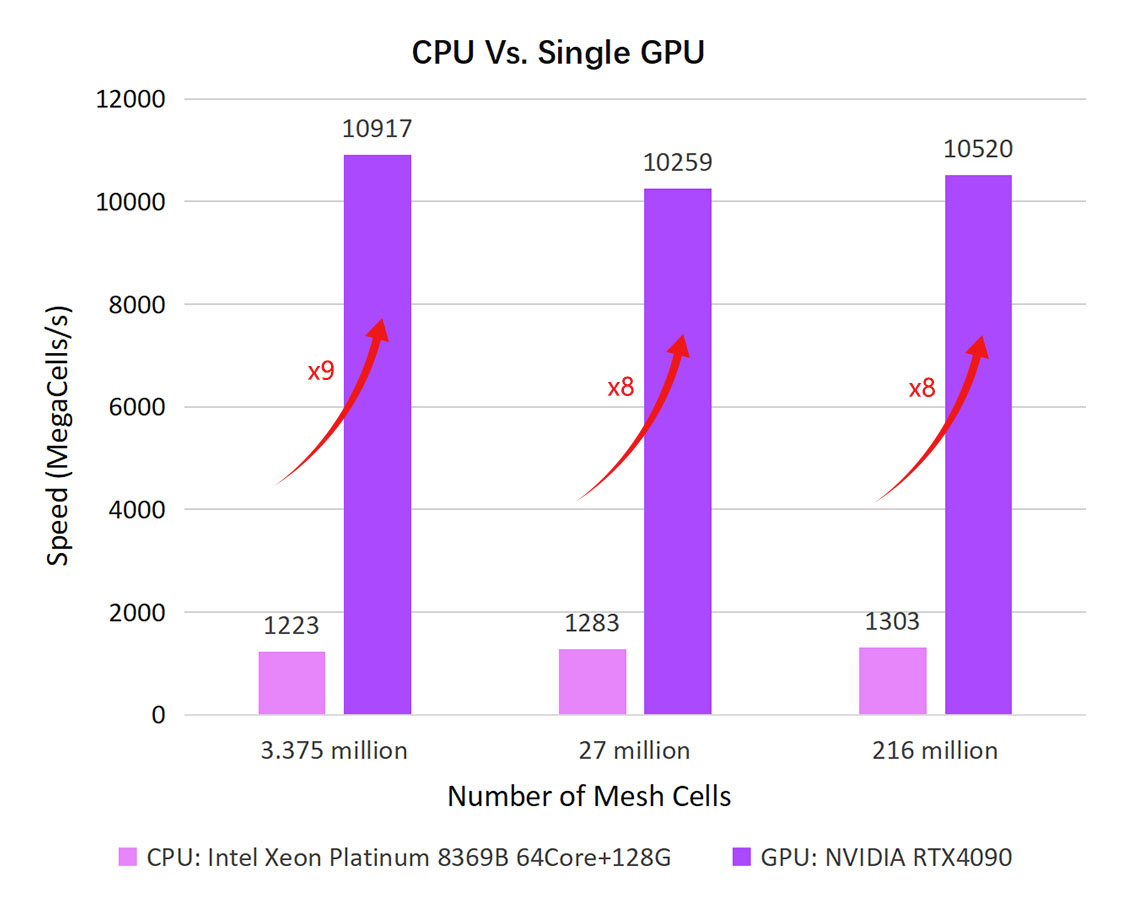
- Heterogeneous Computing Acceleration: Supports hybrid parallel computing with CPU and NVIDIA GPUs. Through GPU acceleration optimized for optoelectronic algorithms, hardware computing speeds can reach 10-15 times that of a CPU.
- Extreme Simulation Efficiency: Under the same computing resources, SimWorks' simulation speed is approximately 50% higher than mainstream industry products; using our cloud computing platform for computation, efficiency can be further increased by 15%-40%.
2. Elastic Cloud Resource Orchestration
- Coverage of Mainstream Cloud Resources: Deeply integrated with major cloud computing providers, offering a rich pool of computing resources for users to choose from.
- Flexible Selection of High-Performance Computing Power: Users can flexibly select the optimal public cloud or private high-performance computing nodes based on the scale and performance requirements of the simulation job (such as mesh density or computing power type) to ensure efficient job execution.
3. Comprehensive Data Security System
- End-to-End Encryption: Implements encryption throughout the entire lifecycle, from simulation job upload and data transmission during computation to the final download of results.
- Multi-level Isolation: Utilizes physical and logical dual isolation mechanisms based on account, job, and storage levels, ensuring complete data independence between different users.
- Security Authentication: Strict identity authentication mechanisms and permission controls prevent unauthorized access and ensure the absolute security of design data.
Flexible Deployment Modes
To meet the needs of users of different scales, SimWorks provides two complementary deployment modes:
Public Cloud Mode — The Optimal Choice for Flexibility and Cost
Target Audience: University laboratories, research institutions, and small-to-medium-sized design teams.
Features:
- Ready-to-use: No hardware deployment required; usable immediately by installing the SimWorks Cloud Computing client.
- Mainstream Integration: Default configuration includes mainstream cloud resources such as Alibaba Cloud, Volcengine, Baidu AI Cloud, and Tencent Cloud.
- Simplified Billing: Interface-based bill management, supporting flexible payment based on simulation computation duration.
Private Cloud Deployment — The Ultimate Guarantee for Security and Autonomy
Target Audience: Enterprise users and national research institutes with extremely high requirements for data compliance and physical isolation.
Features:
- Customized Architecture: Comprised of the cloud computing console, Slurm job scheduling system, and SimWorks server-side software.
- High Autonomy: Supports simulation on enterprise-owned computing clusters, ensuring data stays within the internal network.
- Flexible Deployment: Supports various deployment methods, including binary installation and containerized deployment.
- Hybrid Cloud Capability: Supports simultaneous access to public cloud resources, achieving an organic combination of private and elastic public computing power.
Typical Application Scenarios
- Large-scale Parameter Sweeps: Leverages cloud-based elastic computing power to perform automated sweeping of massive design parameters. Through wide-area searching, it rapidly identifies optimal design regions, addressing the low efficiency of manual parameter tuning in traditional design workflows.
- Automated Inverse Design: Combines advanced gradient optimization algorithms with cloud-based elastic computing to achieve a paradigm shift from "designing structures" to "automatically generating structures." Through large-scale parallelized inverse design in the cloud, users only need to define performance targets, and the system can efficiently complete thousands of automated iterations within the parameter space to achieve optimal designs that surpass human intuition.
- High-Resolution 3D Simulation: For complex micro/nano structures, invokes large-scale GPU-accelerated clusters to perform high-precision, high-mesh-density full-wave electromagnetic simulations, meeting the requirements for extreme performance verification and fine-grained parameter characterization.