

Application Gallery
Planar Silicon Solar Cell
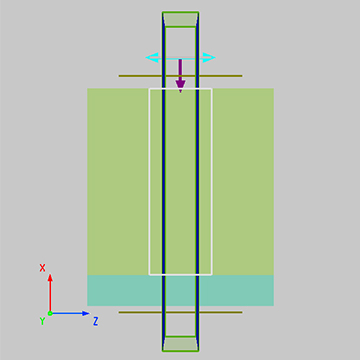
Solar cell is a device that converts solar energy into electricity. When sunlight irradiates a semiconductor material with photovoltaic effect, electron-hole pairs (photogenerated carriers) are generated. An electric current can be produced by inducing electrodes at both ends of the solar cell. In this example, we simulate a planar silicon solar cell by SimWorks Finite Difference Solutions to calculate the absorption of solar energy (300-1100nm) and further to compute the photon generation rate and the corresponding photocurrent.
Photonic Crystal Optical Switch Using Line Defects
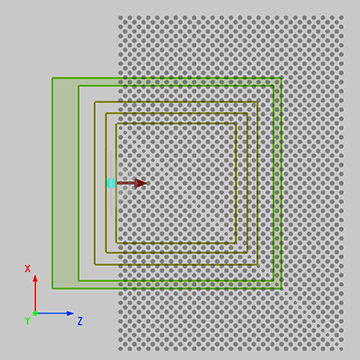
The self-collimation(SC) effect of photonic crystals(PCs) achieves collimated radiation with almost no diffraction effect when the incident light propagates along a particular direction of the crystal. Line defects in 2D PCs cause bending and splitting of the SC beam. In this example, the effect of "optical switching" can be achieved by altering the line defects (radius of the dielectric rod) in the photonic crystal.
Photonic Crystal Bragg Fiber
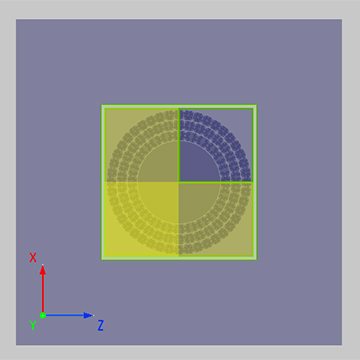
Bragg fiber is a type of air-core fiber that allows light to propagate in the air core, which avoids problems caused by intrinsic material limitation. In this example, we use SimWorks Finite Difference Solutions to calculate the modes of the PC Bragg fiber described by Vienne et al and further compare the results with those from Uranus et al.