

Application Gallery
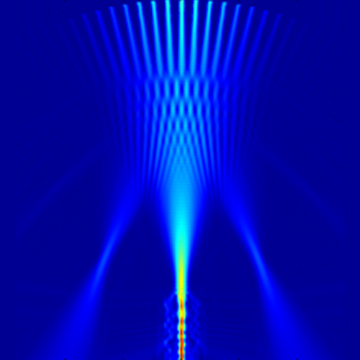
Si-Based Arrayed Waveguide Grating
Arrayed waveguide gratings (AWGs) are essential components in dense wavelength division multiplexed (DWDM) systems. As large-scale photonic integrated devices continue to evolve, the miniaturization design of AWGs has become an important topic. In this example, a 2.5D-FDTD solver in SimWorks Finite Difference Solutions was employed to simulate a saddle-shaped silicon nanowire AWG to investigate its output spectral response and loss.
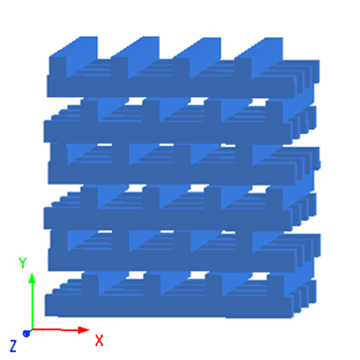
Bandstructure of Woodpile Lattice
In this case, the Woodpile-Lattice photonic crystal is constructed, and the FDTD solver is used to explore the energy bandstructure of the photonic crystal.
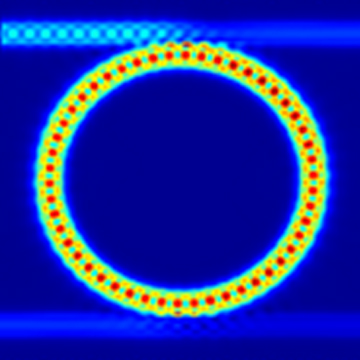
Silicon Based Double Straight Waveguide Microring Resonator
Integrated photonics has become a key enabling technology in areas such as optical communications, sensing, and signal processing. Among various photonic devices, microring resonators are widely used in applications such as filtering, modulation, and nonlinear optics due to their compact footprint, high quality factor, and excellent wavelength-selective properties. In this case, we design and simulate a microring resonator with a center wavelength of 1.55 um and a free spectral range (FSR) of 3200 GHz.
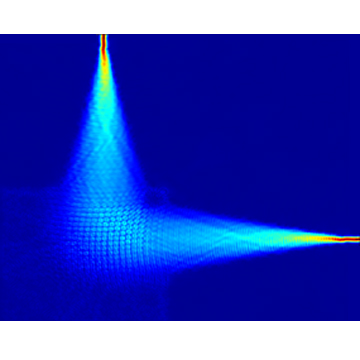
Focusing Polarization Splitting Grating Coupler
The grating coupler has emerged as crucial components in silicon nanophotonics. Addressing the coupling issue between optical fibers and waveguides has become a prominent research focus in recent years. Polarization splitting grating couplers in this case can simultaneously achieve polarization beam-splitting and light coupling functions, which enables the vertical grating coupling between fibers and Silicon-On-Insulator platform for various polarization states. This approach represents one of the most optimal solutions to tackle this issue.
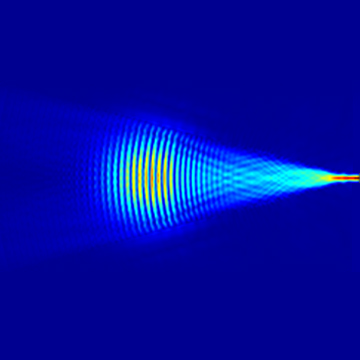
Focusing Grating Coupler
One important issue of silicon photonic circuit is an interface between integrated waveguide devices and optical fibers or free-space optics. Grating couplers have the advantages of easy fabrication, high flexibility, and large alignment tolerance, which makes them the most important solution to solve the coupling issues. In this example, we simulate a focusing grating coupler to study its coupling capability.
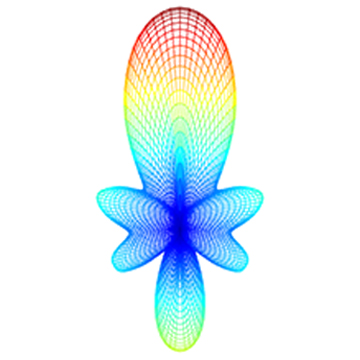
Mie Scattering from a Dielectric Sphere
Mie scattering is an effect that occurs when particles have a size comparable to or larger than the wavelength of the incident light. In this case, we use SimWorks Finite Difference Solutions to calculate the scattering field of a nanoparticle excited by a Total-field Scattered-field(TFSF) light source. The built-in analysis group of Far field from a closed box is then employed to compute the far-field scattering distribution of the particle.
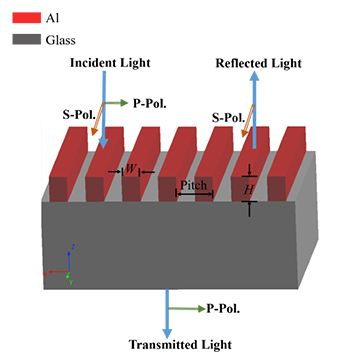
Wire Grid Polarizer
Wire grid polarizer(WGP) is a type of polarizer composed of a metallic grating with a sub-wavelength period and typically made of metals such as gold, silver, aluminum. Due to their advantages, including compact structure, high brightness, high polarization extinction ratio (PER), wide field of view, and ease of integration, WGPs can be widely applied in various fields such as photoswitches, optical displays, and imaging systems. This case is based on the work of Ahn et al. By controlling the grating spacing, duty cycle, and Al grating height, the extinction ratio and transmission optical characteristics can be adjusted.

Bragg Microcavity
Optical microcavities based on optical waveguides typically have a high quality factor and can be applied in various fields such as optical filters, lasers, and modulators. This case aims to analyze the resonance spectrum of a 1D Bragg grating microcavity based on an optical waveguide. Using the FDTD method, the resonant frequencies and quality factor Q are calculated too. By increasing the dimensions of the central structure of the Bragg grating, a defect is introduced that enables the occurrence of transmission resonance within the stopband of the Bragg structure.
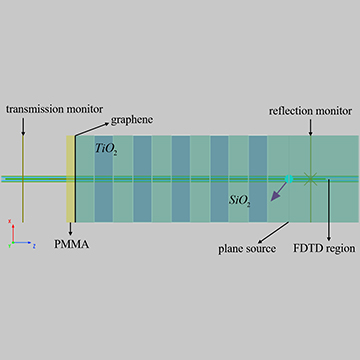
Exciting the Surface Plasmon-Polaritons in Graphene
The chemical potential of graphene can be regulated by methods such as voltage or chemical doping. This property makes graphene highly versatile in the field of material-light interactions, particularly in relation to surface plasmon polaritons (SPPs). By exciting surface plasmons, graphene significantly enhances its ability to interact with light.
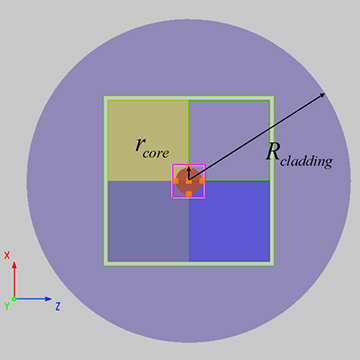
SMF-28 Fiber Mode Calculation
Single-mode fibers feature a smaller core diameter than multimode fibers, enabling the single-mode transmission within the operating wavelength range. This design improves the transmission performance and reliability of single-mode fibers. Single-mode fibers are widely used in communication fields, including long-distance fiber optic communication, data center interconnection, wireless base station backhaul, CATV, fiber optic sensing, etc. This case aims to demonstrate a simple mode calculation by taking SMF-28 single-mode fiber as an example.