

Application Gallery
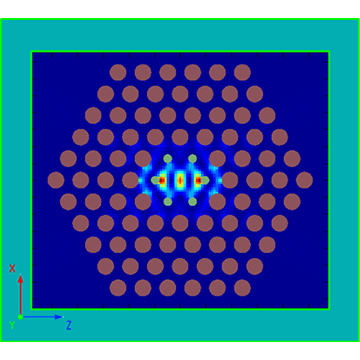
Correcting Field Amplitudes for High-Q Cavities
Generally, in the simulation of high-Q resonant cavities, the field amplitude obtained is inaccurate. The reason is that the loss rate in the high-Q resonant cavity is slow. If the simulation time is not long enough, the field in the cavity will not decay to 0 at the end of the simulation. At this time, the amplitude of the mode field in the cavity needs to be corrected to obtain the final actual amplitude. This case constructs a photonic crystal resonant cavity structure to demonstrate how to correct the field amplitude when the simulation time of a high-Q resonant cavity is insufficient.
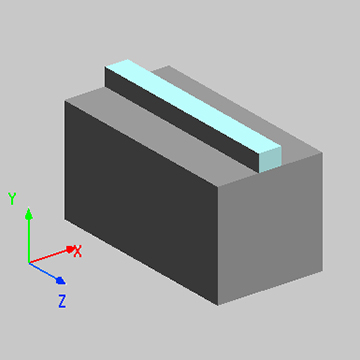
Bandstructure of a Magneto-Optical Waveguide
In this case, the optical waveguide model with periodic structure in the propagation axis is constructed, and the bandstructure of the waveguide is analyzed.
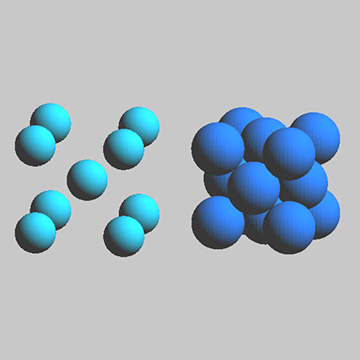
Bandstructure of BCC Lattice and FCC Lattice
In this case, BCC and FCC photonic crystals are constructed and their bandstructures are analyzed using FDTD solvers.
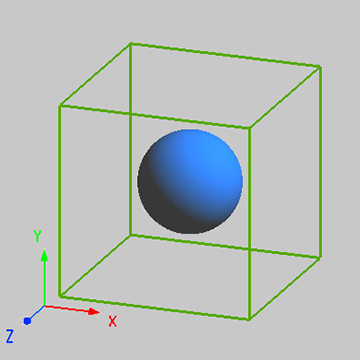
Bandstructure of 3D Cubic Lattice
3D Cubic Lattice is a special case of 3D Rectangular Lattice. The lattice spacing of this type of photonic crystal is equal in three axes in space.

Bandstructure of 2D Triangular Lattice
In this case, a 2D triangular-lattice PC formed by air cylinders arranged in parallel in the medium is constructed, and its bandstructure is calculated.
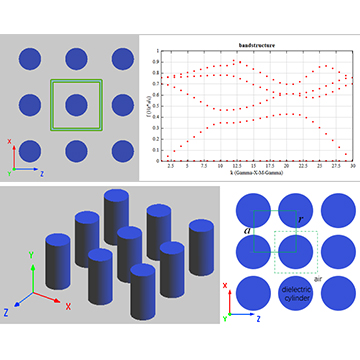
Bandstructure of 2D Square Lattice
Photonic crystals, as a dielectric structure with periodic changes in dielectric constant, can prevent light of a specific frequency from propagating internally, forming a photonic band gap.
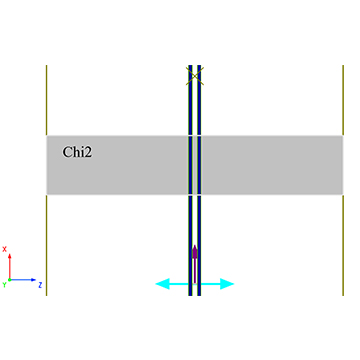
Harmonic Generation with Nonlinear Materials
In nonlinear optics, the interaction between light and media produces nonlinear polarization. Second-order nonlinear effects are widely used in optical frequency doubling, frequency mixing, and modulation, which play an important role in lasers, frequency conversion and other devices. This example will simulate the generation of second harmonic using second-order nonlinear materials.

Multi-Mode Interference (MMI) Coupler
The Multi-mode Interference (MMI) coupler is composed of three parts (input waveguide, output waveguide, and multimode interference region). When the optical field is injected into the multimode interference region through the input waveguide, the interference between multiple modes produces a self-imaging effect. This effect causes periodic generations of one or more images of the input field along the propagation direction of the guided wave. As a result, the MMI can achieve optical wavelength division multiplexing/demultiplexing, power division, polarizing splitter and other functions by this effect.
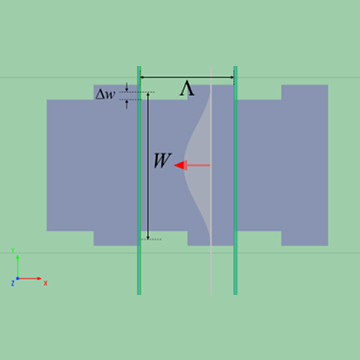
Bragg Grating Based on FDTD
A Bragg grating is an optical device in which there is a periodic variation in the effective refractive index of the structure. The waveguide Bragg grating is a type of one-dimensional photonic crystal structure that enables wavelength selection through periodic modulation of the refractive index. The impact of the geometrical parameters of the sidewall corrugation, such as depth or misalignment, on the performance of Bragg gratings can be analyzed in silicon waveguide Bragg gratings, as demonstrated by Wang et al.
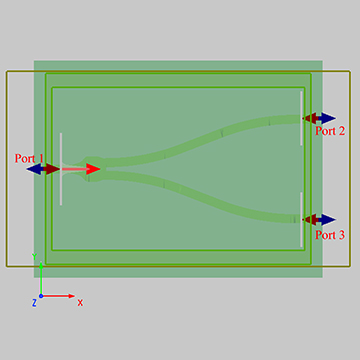
Y Branch
The power splitter based on Y branch distributes optical power to two or more output devices in a certain ratio. In this example, we use SimWorks Finite Difference Solutions to simulate the insertion loss, transmitted power and S-parameters of a symmetric 50/50 Y-branch splitter.