

Application Gallery

Reflective Color Filters
The human eye perceives specific colors in response to specific light spectra. Reflective color filters are used to selectively modulate reflection spectra to provide different color perceptions to the human eye. This case demonstrates how to calculate the chromaticity coordinates related to the reflection spectrum, and further analyzes the color adjustment patterns of the color filter.
Negative Index Metamaterial Using Wire Pairs
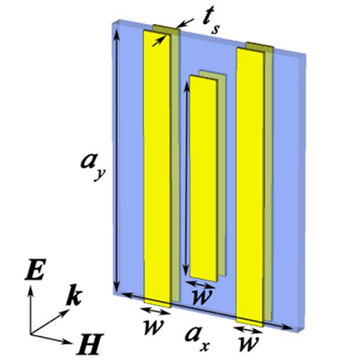
Negative index metamaterial (NIM) refers to an artificial optical structure whose refractive index is negative for electromagnetic waves within a certain frequency range. The purpose of this article is to simulate and explain the metamaterial structure described in the paper written by J. Zhou.
Nanohole Array
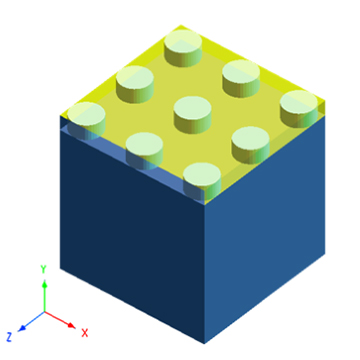
The interaction between incident light and surface electrons of a metallic nanostructure leads to surface plasmon resonance (SPR), which exhibits unique optical properties, including out-of-limit diffraction and local field enhancement. This case involves building a model of a metal film structure with air-hole array and calculating the transmission and reflection spectra of the film by the FDTD method to analyze the near-field distribution on the film surface and the local field enhancement caused by SPR.
Tunable Terahertz Metamaterials Based on Graphene
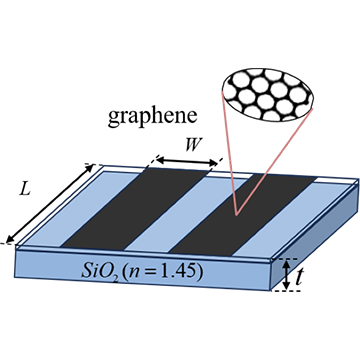
Graphene is a single-layer carbon material that is only one atom thick. It can be used in nanoscale plasmon systems due to its unique physical properties. Light can be manipulated and controlled by adjusting the electrostatic doping or Fermi level to excite plasmon waves in single-layer graphene. According to the research by Chu et al., slight variations in the number of graphene layers and Fermi level can lead to significant changes in the resonant wavelength and modulation intensity. This case aims to simulate this tuning process in 3D FDTD.
Whispering Gallery Modes of a Microdisk
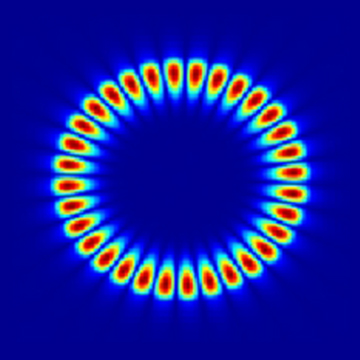
The whispering gallery modes of a microdisk use the total internal reflection (TIR) of light to confine the light within the microdisk to achieve light enhancement. The whispering gallery mode of a microdisk has a high quality factor and a small mode volume, so it is a frontier and popular field of current optical research. In this case, we hope to find the first- and second-order whispering gallery modes of GaN cylinders.
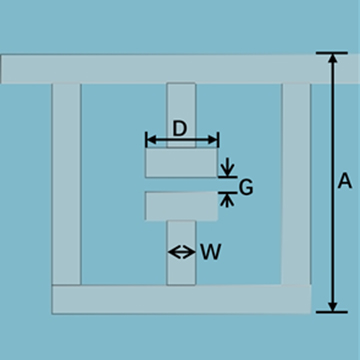
THz Metamaterial
Metamaterial is a man-made material with special properties that is not found in nature. This material can regulate basic physical characteristics such as frequency, amplitude, phase and polarization of electromagnetic waves. This case simulates the passive metamaterial described in the paper Chen et al.
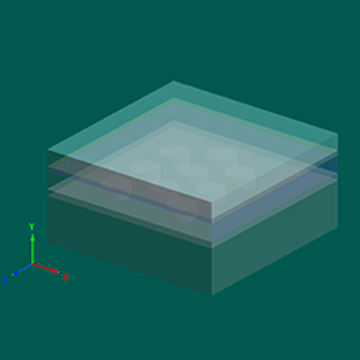
Organic Solar Cell with PC Structure
How to improve Organic solar cells'(OSCs) photoelectric conversion efficiency (PCE) is an urgent problem to be solved. One of the more commonly used methods is to add micro-nano structures for light trapping into the photoactive layer of OSCs to increase light absorption, thereby improving PCE. The photonic crystal (PC) structure is used in the photoactive layer of OSCs, which can enhance the light absorption of solar cells in specific wavelength bands. This case uses FDTD simulation to analyze the light absorption of an OSC with a 2D hexagonal-lattice PC structure.
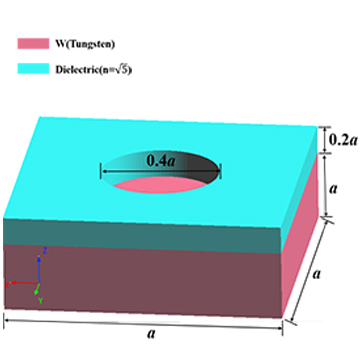
2D-Periodic Metallic Photonic Crystal Slabs
The ability to modify an object's thermal radiation profile is important in many areas of applied physics and engineering. It has been noted that periodic engineering of devices made of metallic and dielectric materials at the subwavelength scale can change the thermal radiation properties of the device. This case studies the thermal radiation of a photonic crystal obtained by periodically arranging a device made of metallic tungsten and a dielectric material.
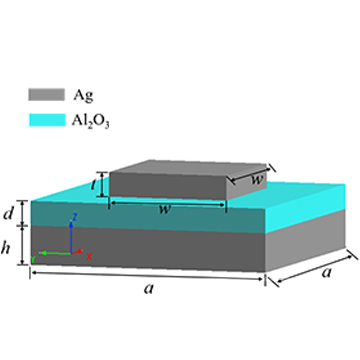
Plasmonic Metamaterial Infrared Absorber
Metamaterial is a special type of man-made material with extraordinary physical properties that natural materials do not have, such as regulating the frequency, amplitude, phase, etc. of electromagnetic waves. This case models and simulates a Metal-Insulator-Metal (MIM) plasmonic metamaterial infrared absorber to study its reflection/transmission/absorption characteristics in the visible to near-infrared band.
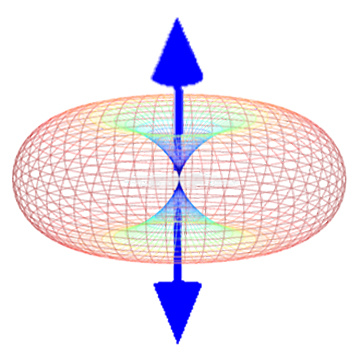
Far Field Analysis - Directivity
Directivity is defined as the ratio of the radiation intensity in a specified direction to the average radiation intensity. It is obtained through further analysis of far-field data and is one of the important parameters describing far-field radiation characteristics. In the FDTD solver of the SimWorks optical finite-difference solution, the Directivity analysis group can be used to further analyze and calculate the far field.