

Application Gallery
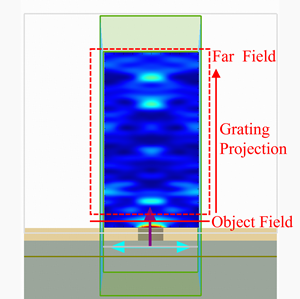
Using grating projections calculate fields at an arbitrary location
In FDTD simulations, obtaining the field distribution at locations far from a device usually requires expanding the simulation domain so that light can fully propagate to the target plane. While this approach is straightforward, it significantly increases computational cost and simulation time. This case presents a Grating Projection(GP)–based approach that can quickly obtain the distribution of fields propagating in homogeneous media at any specified location, and verifies its accuracy through comparison with FDTD simulation results.

Focusing with a single subwavelength aperture
Subwavelength optical devices hold great potential in light field manipulation and photonic integration. However, at subwavelength scales, light undergoes strong interference and diffraction, making it difficult to achieve efficient focusing. Garcia-Vidal et al proposed a structure consisting of a single subwavelength aperture in a metallic film surrounded by periodic surface grooves. By exciting surface plasmons, this design enables far-field focusing. In this case, we reproduce the structure with FDTD simulations and analyze the focal spot size to demonstrate its focusing capability.
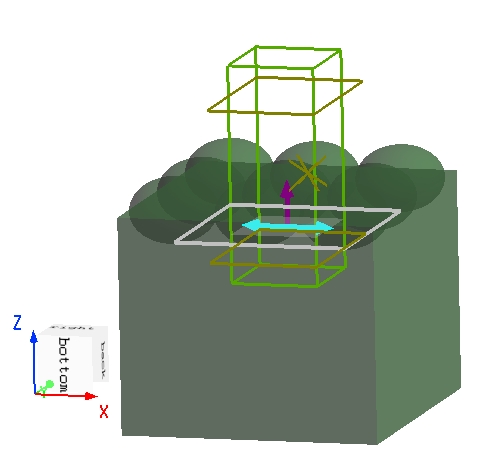
Diffraction Grating
The Diffraction grating is a classic type of periodic optical element, widely used in fields such as spectroscopy, laser beam control, and beam splitting. Their functionality relies on spatially modulating the wavefront of incident light to generate a series of discrete diffraction orders in specific directions. Since a grating's performance is governed by its diffraction-order energy distribution, precise quantification of this distribution becomes critical for design optimization. This case demonstrates how to use the grating projection functions in an FDTD simulation of a two-dimensional periodic grating, allowing for accurate evaluation of the energy distribution among diffraction orders and their corresponding efficiencies.
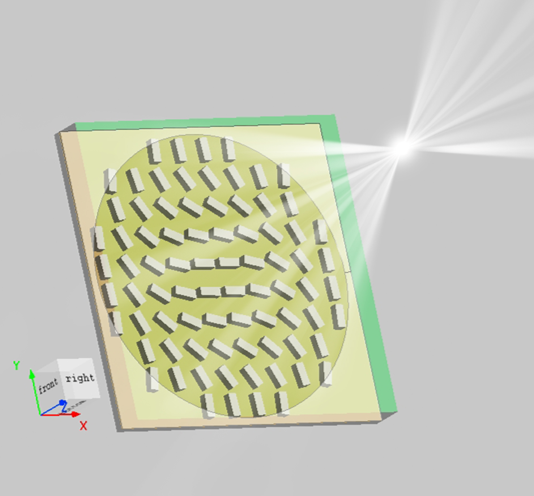
Metalens Based on PB Phase
Traditional curved optical lenses rely on phase accumulation along the light path to control light, which is limited by the refractive index of natural materials. To correct various image aberrations, multiple lenses are usually needed. However, combining multiple optical lenses occupies a lot of space, making it difficult to miniaturize optical systems. Metalenses, however, manipulate incident light to bend beams through the arrangement of artificial sub-wavelength units on the dielectric surface. A single metalens can achieve the same performance as a device that requires multiple optical lenses. Compared to traditional optical lenses, metalenses are smaller, lighter, cheaper, have better imaging quality, and are easier to integrate. They provide a new solution for compact integrated optical systems. This case study, based on the research of Xicheng Xia and Zan Yao, introduces how to use FDTD to simulate metalenses, helping readers achieve miniaturization of optical systems.
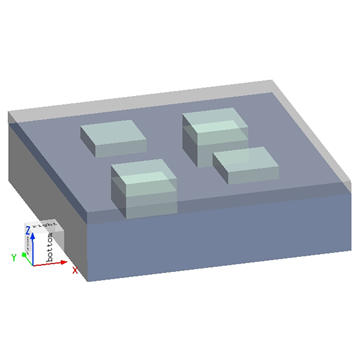
Lithography Using Alternating Phase Shift Mask
The demand for smaller, faster, and lower power semiconductor devices continuously drives advances in optical lithography technology. As the size of semiconductor devices continues to shrink, it is necessary to use alternating phase shift masks (APSM) to improve resolution. For example, at the 45nm node, some features to be imaged are smaller than the diffraction limit of the 193nm light source used. APSM modulates the phase so that the light interferes with itself after passing through the mask, making the mask pattern edges sharper and clearer, thereby improving pattern contrast. The proximity effects occurring at sub-wavelength scales need to be understood through lithography simulation, so they can be accounted for in mask design, ensuring a predictable and reliable process. This case demonstrates how to image sub-wavelength features using APSM in FDTD.
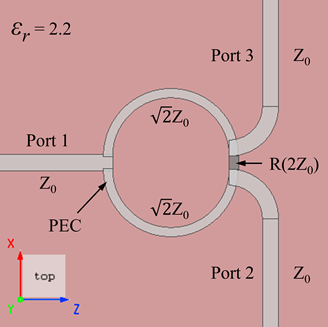
Wilkinson Power Divider
The Wilkinson power divider is a three-port device used for power distribution. Compared to a conventional T-junction power divider, it can match all ports and achieve arbitrary power distribution. Unlike resistive power dividers, the Wilkinson power divider not only can isolate the output ports but also indicate no loss when the ports are matched, only dissipating reflections from the output ports. This case models and simulates an equal-split (3dB) Wilkinson power divider designed in Example 7.2 from Pozar.
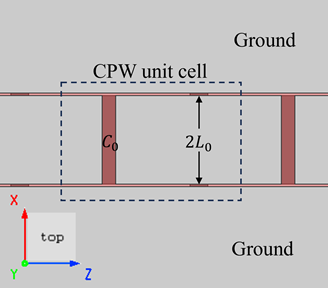
Negative Refractive Index Transmission Line Phase Shifter
Antoniades et al. proposed a new type of negative refractive index(NRI) coplanar waveguide(CPW) transmission line(TL), which can be used after conventional TL for phase compensation, allowing the design frequency to propagate through all TLs to achieve positive, negative, or zero phase shifts. The propagation characteristics of this NRI metamaterial are mainly determined by lumped elements. Therefore this new NRI-TL can change the phase characteristics by simply adjusting the value of the lumped element instead of adjusting the length. Thus, this new NRI-TL offers significant advantages over conventional delay lines ( its compact size, simplicity, ease of fabrication for planar microwave circuits, and linear phase response near the design frequency). This case study references Antoniades' work and models a zero-phase-shift NRI-TL operating at a frequency of f=1GHz.
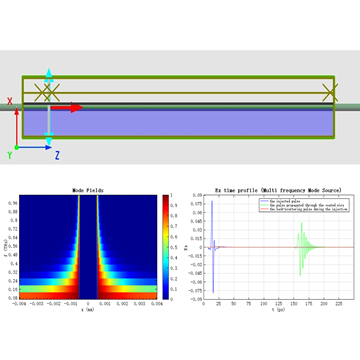
Mode Source in Broadband Simulations
By default, mode source calculates mode at central frequency of the specified frequency range and then injects this mode at all frequencies, which is very effective in single-frequency and narrowband simulations. However, in broadband simulations, mode-mismatch errors increase as frequency range expands. In this example, the multi-frequency field of the mode source will be demonstrated using a copper wire with a thin dielectric coating operating in the broadband terahertz range.
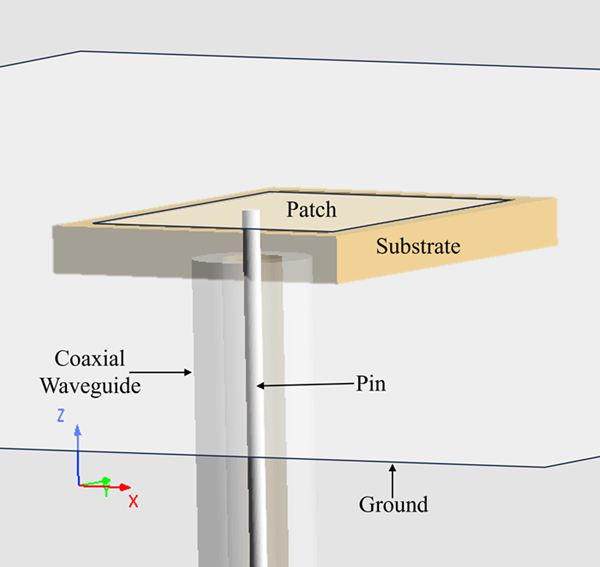
Coaxial-Fed Rectangular Patch Antenna
Coaxial-fed rectangular patch antenna is a fundamental type of microstrip antenna composed of a dielectric substrate, a ground plane, and a conductive patch. Compared to traditional antennas, Coaxial-fed rectangular patch antennas are compact, lightweight, easy to integrate, cost-effective, and suitable for mass production. In this case, a rectangular patch antenna mounted on an infinite metal ground plane is simulated using FDTD, and its return loss and far-field directivity are calculated.
Tamm Plasmon Polaritons Generated by Bragg Grating
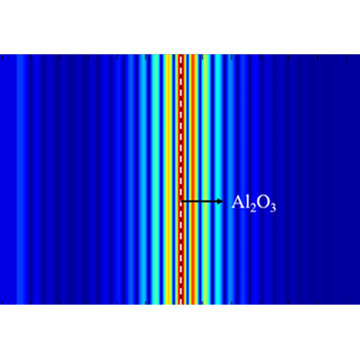
In 2007, Kaliteevski et al. successfully excited Tamm plasmon polaritons (TPPs) between metal and Bragg gratings. The TPPs can be directly excited since the dispersion curves of TPPs lie within the light cone. Additionally, both TE and TM polarized light can be stimulated in TPPs since there is no requirement for the angle of incidence. These characteristics make TPPs popular in the fields such as surface light enhancement, nonlinear optics, and lasers. This case will simulate and study this process.