

Dielectric Material, (n, k) Material, and Conductive Material #
This section describes dielectric, (n, k), and conductive materials in the optical material library.
Dielectric Material #
Dielectric materials are dispersion-free, with their material parameters determined exclusively by the refractive index n, which is independent of frequency/wavelength, and remaining constant across all frequencies.
While the Kramers-Kronig relation states that the imaginary part k of the refractive index of a material cannot be zero for all frequencies, dielectric materials can still be used as an approximation to describe materials with a constant refractive index (i.e., non-dispersive materials).
The relative refractive index n of a dielectric material must be greater than or equal to 1.
| Name | Symbol | Range | Default | Description |
|---|---|---|---|---|
| Relative index | n | n≥1 | 1 | Relative refractive index: Used to describe non-dispersive materials with a constant refractive index. |
Material Setting #
The Optical Material Library provides a collection of commonly used dielectric materials. However, users also have the flexibility to add custom dielectric materials as needed, by selecting Add material>Add dielectric.
To add a dielectric material with diagonal anisotropy, you need to enable the Anisotropy (Diagonal) option and define the relative refractive index for each direction.
For more information, please refer to Optical Material.
More Information #
Custom Defined Dielectric #
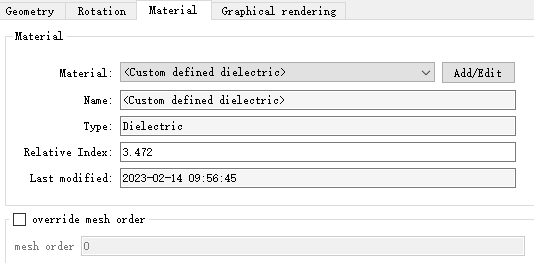
Due to the simplicity and wide applications of dielectric materials, the Edit structure page allows users to quickly define the refractive index value for a material.
In the Structure > Edit structure properties window, you can switch to the Material page, then select "Custom defined dielectric" and enter the desired material refractive index n in the Relative index.
(n, k) Material #
(n, k) materials are suitable for the single frequency simulations, using the complex refractive index N to define n and k of the material.
N=n+iκ
Wherein, n is the real part of N, which represents the relative refractive index; and κ is the imaginary part of N, which represents attenuation.
| Name | Symbol | Range | Default | Description |
|---|---|---|---|---|
| Relative index | n | Real number, n≥0 | 1 | Real part of the complex refractive index N. |
| Imaginary relative index | κ | R | 0 | Imaginary part of the complex refractive index N. |
Material Setting #
In the Optical Material Library window, you can add a (n, k) material model by selecting Add material>Add (n, k) material, and modify the material parameters in the pop-up window to create the desired (n, k) material model.
More Information #
Broadband Simulation of (n, k) Material #
(n, k) materials are only used for monofrequency simulations. When applying (n, k) materials to broadband simulations, accuracy of the refractive index is guaranteed only at the center frequency point.