

Mesh Refinement
Mesh Refinement #
This section describes mesh refinement settings. All three mesh types supported by the FDTD solver (Uniform Mesh, Auto Nonuniform Mesh, and Semi-auto Nonuniform Mesh) support every refinement method listed below. Solvers such as FDFD, FDE, EME, and RCWA support only a subset of the refinement methods listed below. The FDCharge solver does not provide Mesh refinement options and is not covered by this section.
Mesh refinement is used to improve the accuracy of calculations at material interfaces in simulations, effectively reducing numerical dispersion and errors. Note that mesh refinement does not change the mesh partitioning itself but influences simulation results by calculating the effective permittivity within mesh cells. The main mesh refinement methods include:
- Staircase: When a single mesh cell contains multiple materials, the staircase refinement method fills the entire cell with a single material.
- Conformal: The conformal refinement method calculates the average permittivity of subcells at material boundaries, achieving higher interface resolution. Conformal refinement can yield accurate results even with relatively coarse meshes.
The software currently supports the following mesh refinement methods:
| Name | Description | Applicable Scenarios and Recommendations |
|---|---|---|
| Staircase | Assigns a single material property to the mesh based on whether the Yee mesh center is within the structure. | Suitable for structures with regular boundaries or simulations where boundary accuracy is not critical. |
| Conformal variant V-EP | Calculates the effective permittivity by averaging the volumes of different materials within the same mesh. | Suitable for quick conformal mesh construction for non-dispersive materials. |
| Conformal variant VP-EP 0 | Calculates the effective permittivity based on material proportions and the normal direction of the electric field at material boundaries. | The default refinement method in the software, applicable only to non-dispersive materials. |
| Conformal variant VP-EP 1 | An extended algorithm of VP-EP 0 for dispersive materials; supports both dispersive and non-dispersive materials but reduces computational speed due to dispersion current calculations. | Suitable for high-accuracy simulations requiring dispersion effects. Note: Simulations may occasionally diverge when VP-EP 1 materials extend through PML boundary conditions. |
| Conformal variant Yu Mittra 1 | Modifies Maxwell's equations near conductor surfaces using loop integration, where the internal electric field of an ideal conductor is 0. | Suitable for electromagnetic simulations involving metallic structures, such as antennas and waveguides. |
| Conformal variant Yu Mittra 2 | Calculates the effective permittivity at dielectric or non-metallic material surfaces based on the weighted average of lengths occupied by different materials on the corresponding Yee mesh edge. | Applicable to conformal mesh discretization of dielectric or non-metallic materials. |
Mesh Refinement Subcells #
Conformal refinement methods support subdividing a single mesh into multiple subcells to calculate more accurate effective permittivity. More subcells result in higher accuracy but also increase computational load. The default settings are usually sufficient, but users can increase the number of subcells for special high-accuracy requirements.
This parameter can be found in the Mesh generate section under the solver's Advanced tab. Except for Staircase, all other refinement methods include this parameter. In 2D simulations, a single mesh is subdivided into N×N subcells; in 3D simulations, it is subdivided into N×N×N subcells, where N is the user-specified value.
| Name | Default | Description |
|---|---|---|
| Mesh refinement subcells | 20 | Specifies how many subcells a single mesh is divided into for effective permittivity calculations. |
The use geometric volume fraction method for mesh conformal option is also available at the same location. This option adopts an optimized conformal mesh refinement method that performs precise equivalent material parameter calculations on subcells, making it especially suitable for mesh partitioning at multi-material interfaces. It significantly accelerates mesh generation while maintaining or improving simulation accuracy, effectively reducing meshing difficulty and computational resource consumption. When this option is checked, only a few structures are affected by the subcells value, and the default subcells value is 20. If abnormal simulation results occur, uncheck this option to revert to the traditional conformal mesh refinement method.
Case Study: Combination Effect of Different Mesh Types and Refinement Methods #
Create a simple dielectric sphere model with a relative refractive index of N=3.472 to compare how different mesh types and refinement methods affect mesh generation.
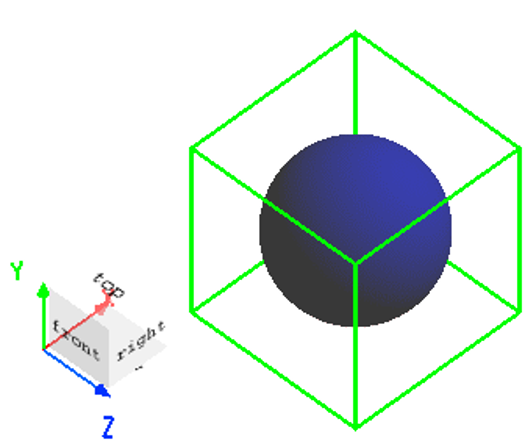
Use the following mesh type and refinement combinations:
| Name | Mesh type | Mesh refinement | Description |
|---|---|---|---|
| (a) | Uniform | Staircase | Uniform mesh with staircase refinement; simple and efficient. |
| (b) | Auto nonuniform | Staircase | Auto nonuniform mesh adaptively refines around the structure, balancing efficiency and accuracy. |
| (c) | Uniform | Conformal variant VP-EP0 | Uniform mesh with conformal refinement; better for curved boundaries. |
Use View the current material data to inspect the material distribution for each setup ((a), (b), and (c) correspond to the results from left to right in the figure below; try other combinations as needed):
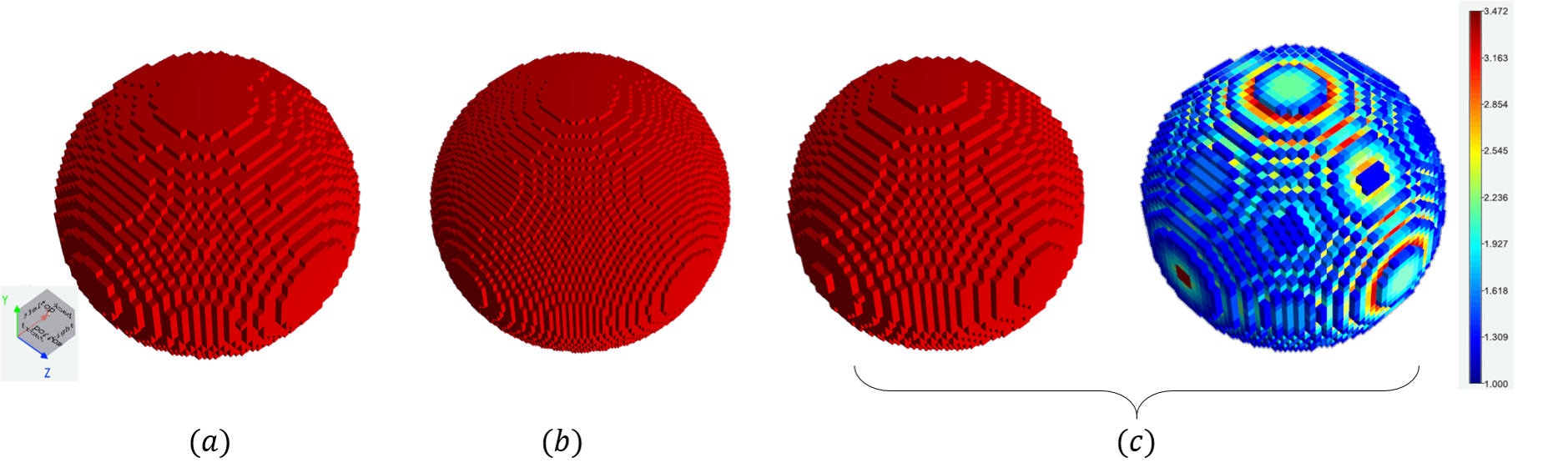
Add an Index monitor to view the material distribution in the central cross-section.
Related Publications #
[1] Yu W, Mittra R. A conformal finite difference time domain technique for modeling curved dielectric surfaces[J]. IEEE Microwave and Wireless Components Letters, 2001, 11(1): 25-27.
[2] Taflove A, Hagness S C, Piket-May M. Computational electromagnetics: the finite-difference time-domain method[J]. The Electrical Engineering Handbook, 2005, 3: 629-670.
[3] Zhao Y, Hao Y. Finite-difference time-domain study of guided modes in nano-plasmonic waveguides[J]. IEEE transactions on antennas and propagation, 2007, 55(11): 3070-3077.
[4] Mohammadi A, Nadgaran H, Agio M. Contour-path effective permittivities for the two-dimensional finite-difference time-domain method[J]. Optics express, 2005, 13(25): 10367-10381.