

Symmetric/Anti-Symmetric Boundary
Symmetric/Anti-Symmetric Boundary #
Symmetric and anti-symmetric boundaries are used to exploit geometric and field mirror symmetry, reducing the solution domain and improving computational efficiency. They are especially useful when the structure exhibits plane symmetry or center symmetry and the source distribution satisfies the corresponding symmetry condition.
Basic concept #
Symmetric and anti-symmetric boundary conditions exploit the mirror relationship of a structure and its electromagnetic field: if a model has geometric, material, and excitation symmetry with respect to a certain plane, only half or an even smaller portion of the domain needs to be simulated to obtain the response of the full model. The core idea is to impose mirror constraints on the field components at the boundary, which is mathematically equivalent to “completing” the field on the other side without explicitly modeling the entire structure.
For this boundary condition to be valid, the simulation domain itself must obey the same symmetry. Specifically:
- a symmetric boundary requires the fields on both sides of the boundary to have the same parity;
- an anti-symmetric boundary requires the fields on both sides to be opposite;
- these constraints can be used to reduce the computational domain, lowering the solution size and improving efficiency.
The electromagnetic field distribution at a symmetric or anti-symmetric boundary can typically be equivalently represented by the method of images, as shown below:
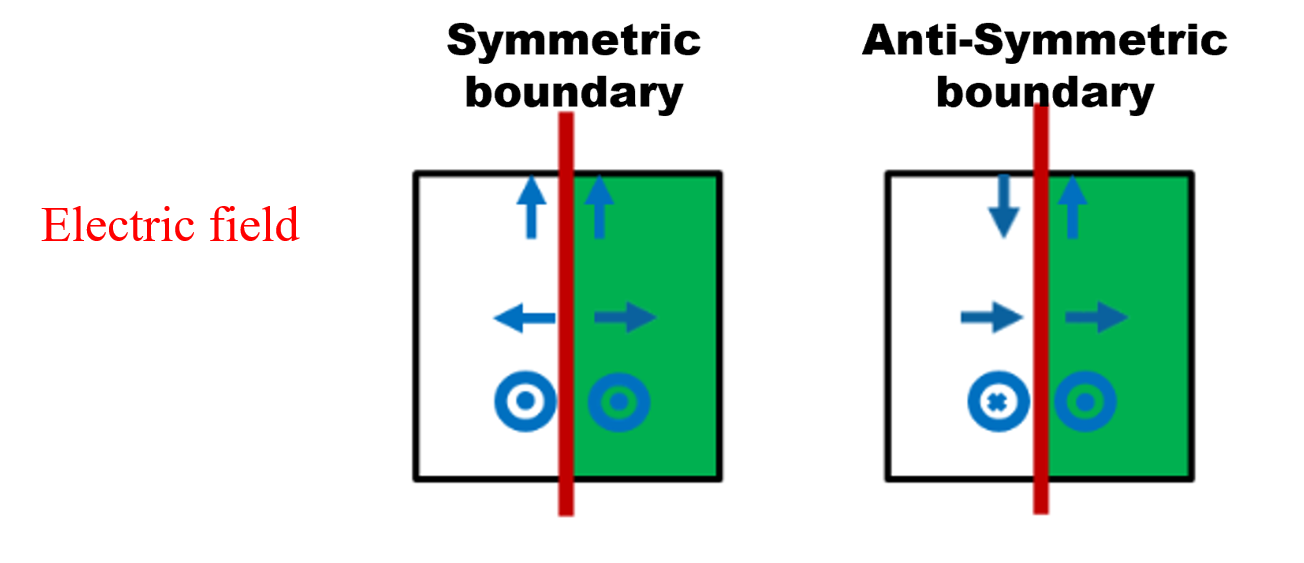
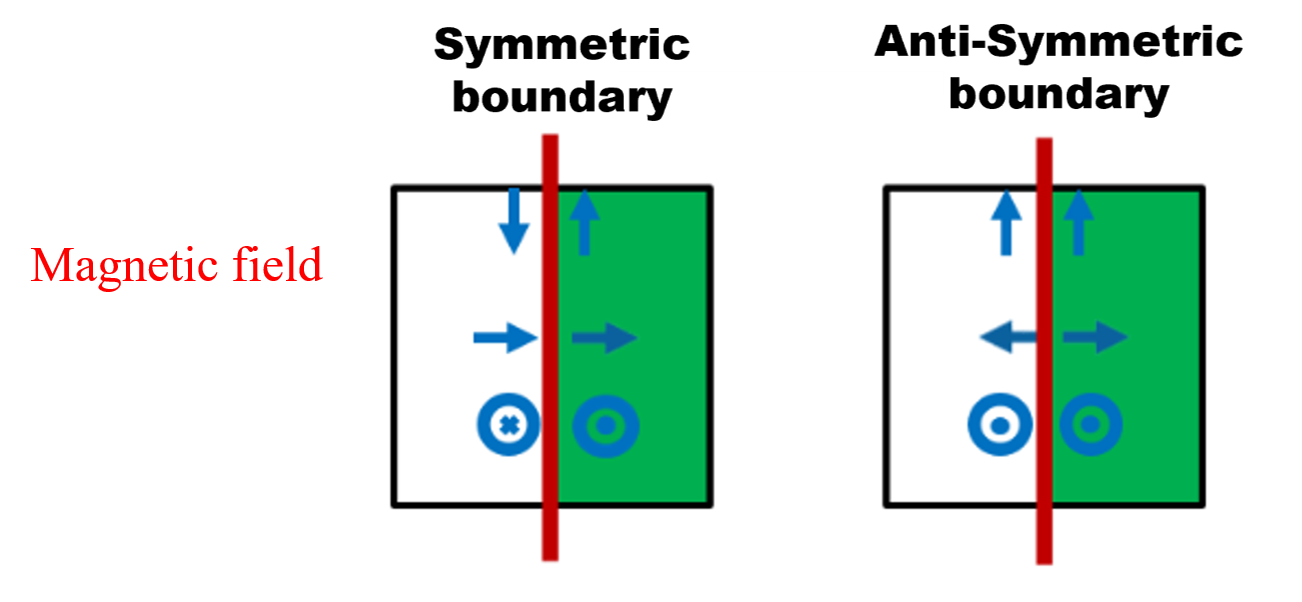
This boundary condition is most effective when the structure has plane symmetry, center symmetry, or a specific mirror feature. It is not merely a convenience for drawing half of a model; it is a strict constraint based on the physical field satisfying a mirror relationship. If the structure or excitation breaks the symmetry, forcibly applying a symmetric or anti-symmetric boundary would make the model inconsistent with the true physics.
Applicable scenarios #
Symmetry and anti-symmetry boundaries are commonly used in:
- structures with mirror symmetry;
- source distributions that satisfy symmetry or anti-symmetry conditions;
- cases where reducing the simulation domain can significantly speed up computation;
- periodic and mirror-related structure analyses.
Usage requirements #
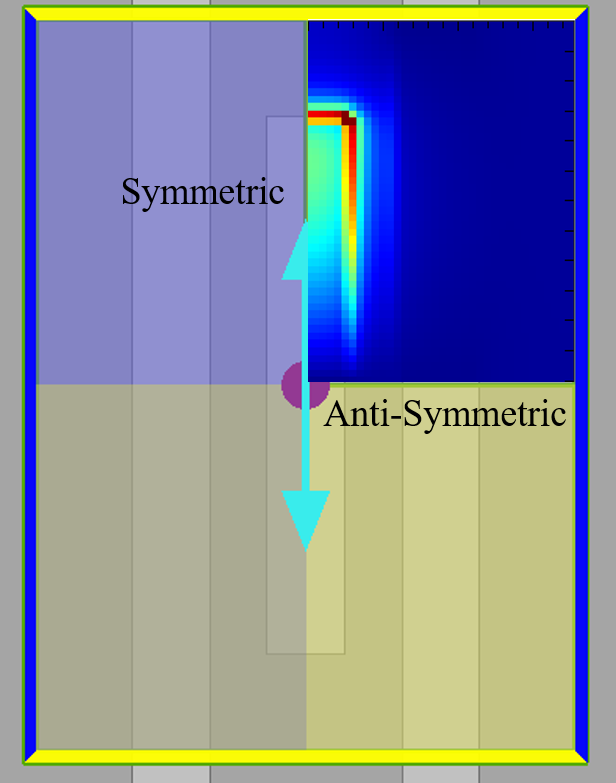
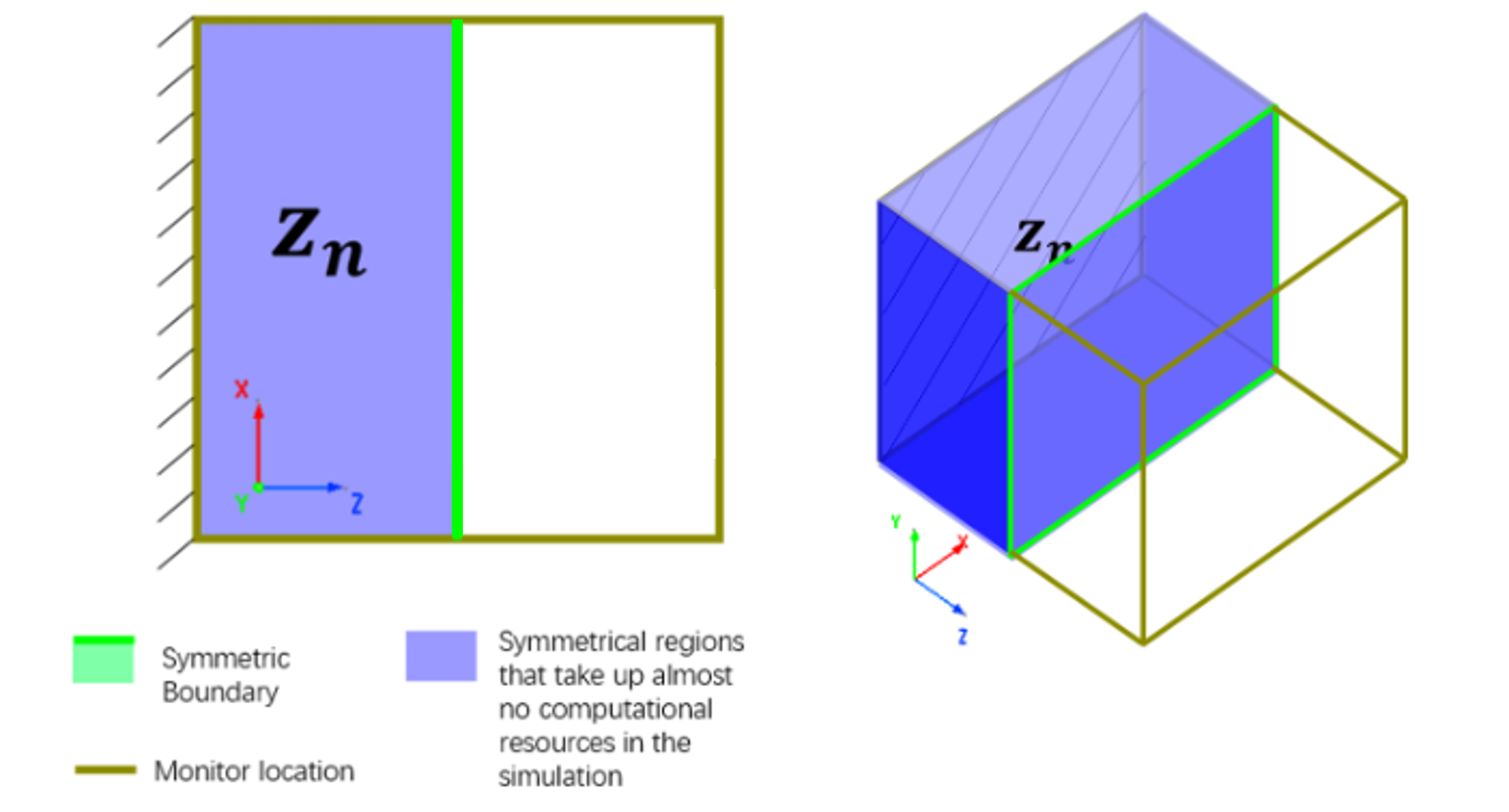
The symmetry/anti-symmetry boundary requires not only symmetry in the physical structure (including geometry and materials), but also symmetry in the field distribution of the source. Leveraging this symmetry can reduce the calculation space by half in each direction and greatly speed up the simulation.
Typical requirements include:
- the device geometry and material distribution should be symmetric near the selected boundary;
- the simulation domain and boundary settings should be consistent with the chosen symmetry type;
- the source position, polarization, and phase should match the required symmetric or anti-symmetric condition.
Notes #
- Symmetric/anti-symmetric boundaries are valid only when the geometry, material distribution, and source fields satisfy the corresponding mirror symmetry; they are invalid if local defects or disturbances near the boundary break symmetry.
- If the source does not meet the mirror-symmetry condition, the results may be inaccurate—re-evaluate before applying symmetry boundaries.
- Problems with bias, coupling, or inherently asymmetric excitation generally cannot use symmetry boundaries.
- When conditions are met, symmetry boundaries reduce the simulation domain and accelerate computation; ensure geometry, source, and materials are consistent with the chosen symmetry.
- For periodic problems that also satisfy mirror symmetry, symmetry boundaries can be combined with periodic settings to further reduce computational cost.