

Periodic Boundary
Periodic Boundary #
Periodic boundary conditions are used for systems with repeating structures along one or more coordinate directions. By simulating only one unit cell, you can model the response of the entire periodic array or medium efficiently.
Basic concept #
The core idea of a periodic boundary is translational invariance: when the structure, material distribution, and excitation repeat regularly along one or more directions, the solution in one unit cell can be extended to neighboring cells by a translation of one period. Mathematically, this means
E(r+a)=E(r),H(r+a)=H(r)
where a is the lattice vector along the periodic direction. In practical terms, the field on one boundary is identical to the field on the opposite boundary after one cell translation, allowing an otherwise infinite periodic system to be represented by a finite computational domain.
This boundary condition is widely used for repeated structures such as gratings, metasurfaces, array antennas, photonic crystal unit cells, and periodically patterned dielectric or metallic devices. It preserves the cell-to-cell coupling relationship while avoiding the need to simulate every repeated unit in the entire infinite structure.
It is important to note that periodic boundaries require true translational periodicity in geometry, materials, and excitation. If the model contains a local defect, edge truncation, or a non-periodic source near the boundary, directly applying periodic boundary conditions will introduce an invalid assumption and produce unphysical results.
Applicable scenarios #
Periodic boundaries are suitable for problems where:
- the structure repeats regularly along one or more directions;
- the goal is to represent an effectively infinite periodic array in a finite computational domain;
- the analysis focuses on the aggregate response of a periodic structure instead of a single local defect.
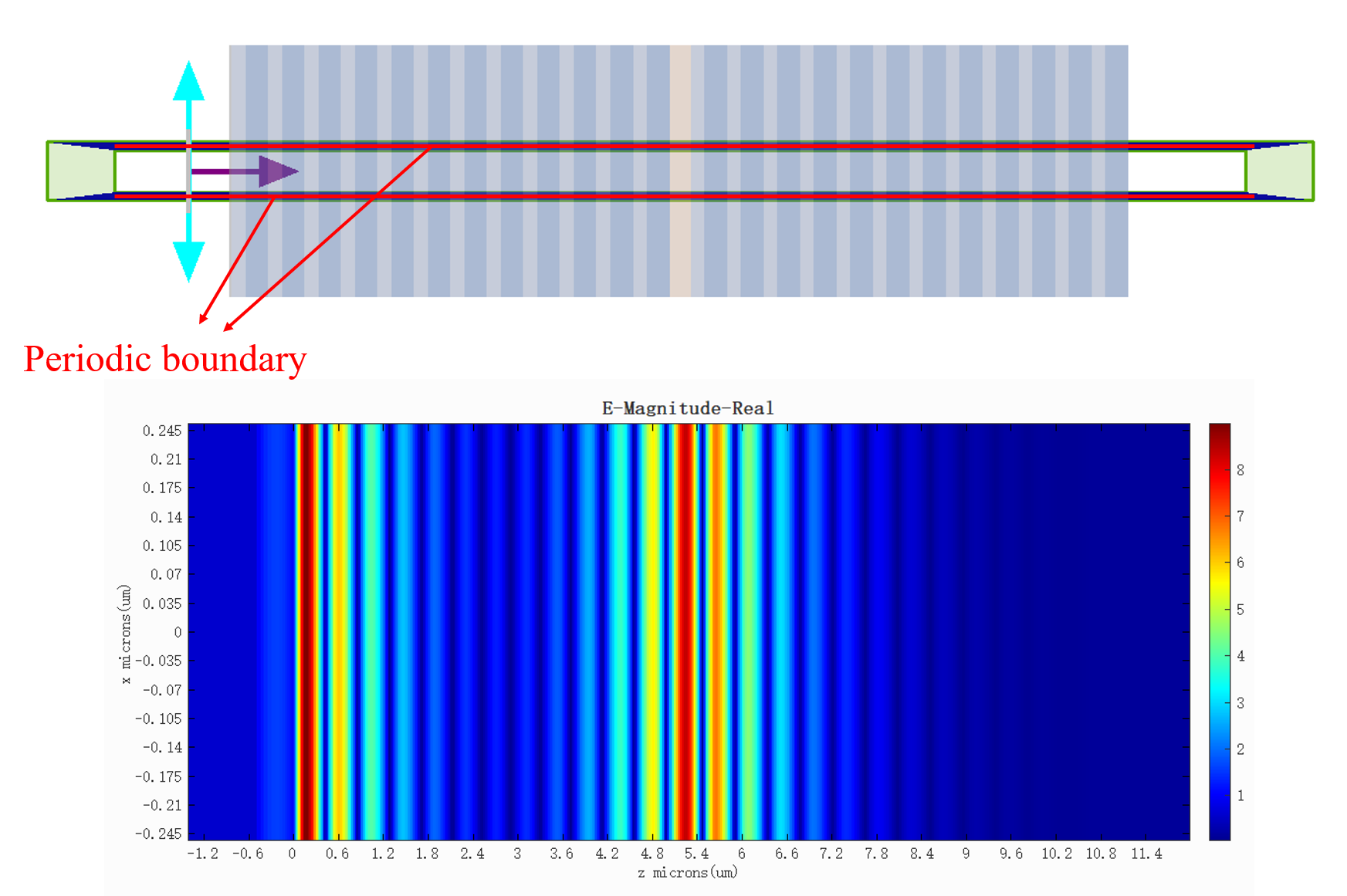
Usage requirements #
- For periodic/Bloch boundaries in the same direction (X/Y/Z), the upper and lower boundary conditions must be consistent.
- When periodic boundary conditions are applied, the geometry, material distribution, and electromagnetic field must all be periodic.
- The boundary direction cannot contain non-periodic features such as local defects, edge truncation, or single-source excitation that breaks the periodicity.
Notes #
- Use periodic boundaries only when geometry, materials, and sources are strictly periodic; do not apply them to models with local defects, truncated edges, or isolated incoherent sources.
- For oblique incidence or non-zero phase offsets, use Bloch boundary conditions to preserve phase relationships.
- If periodicity holds only in part of the model or truncated features exist near the boundary, increase the unit cell size or use a finite-size model to avoid invalid assumptions.
- For band-structure, dispersion, or angle-dependent analyses, combine sweep parameters with Bloch/wave-vector settings to obtain physically meaningful results.
- Verify repeatability along the chosen direction before applying periodic boundaries.