

PEC / PMC
PEC / PMC #
Basic concept #
PEC (Perfect Electric Conductor) and PMC (Perfect Magnetic Conductor) are both idealized boundary conditions used to approximate ideal electric or magnetic walls in numerical simulations. They are not physical material models with finite loss, dispersion, or surface impedance; instead, they impose exact electromagnetic constraints at the boundary to simplify the problem and represent idealized structural interfaces.
PEC #
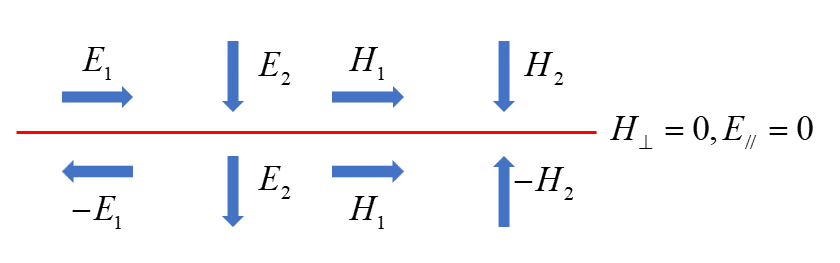
PEC is the mathematical model of an ideal metal surface. Its defining conditions are:
- tangential electric field = 0;
- normal magnetic field = 0;
- used to approximate ground planes, metal walls, conducting shells, and highly conductive interfaces.
Physically, an ideal conductor screens the electric field so strongly that no tangential electric field can exist at the surface. This makes PEC a common choice for metal-backed structures, antenna grounds, and resonator walls.
PMC #
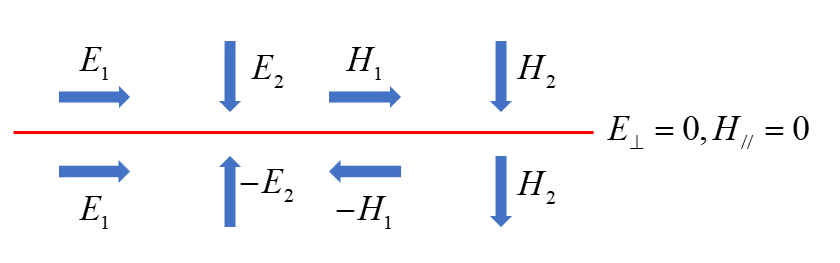
PMC is the ideal magnetic-wall model. Its defining conditions are:
- tangential magnetic field = 0;
- normal electric field = 0;
- often used in theoretical analysis, symmetry reduction, and mirror-related simplifications.
PMC is not a realistic material but a useful abstraction for describing the symmetry or duality of electromagnetic fields. It is especially valuable in simplified theoretical models, mirror-image analyses, and boundary-condition construction for idealized problems.
Illustrations for PEC / PMC:
Applicable scenarios #
- PEC: ideal metal surfaces, ground planes, conducting shells, and metal-backed structures.
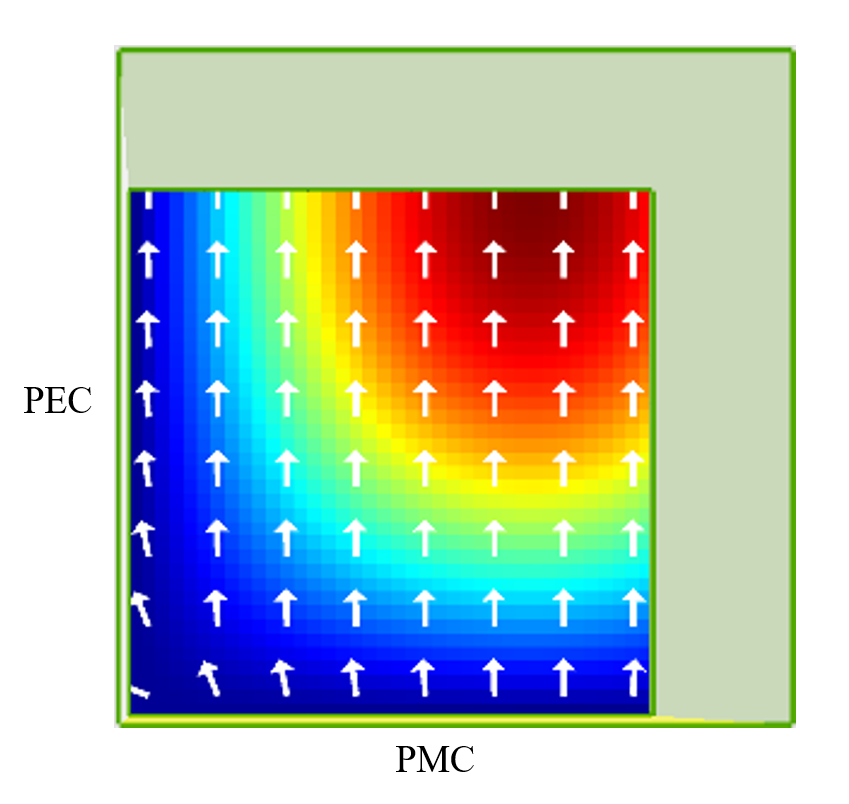
- PMC: theoretical magnetic-wall models, symmetry-based reductions, and mirror/anti-mirror analysis in idealized waveguide or resonator problems.
Usage requirements #
- Use the model only when the surface can reasonably be treated as an ideal electric or magnetic wall.
- For realistic loss, surface impedance, or frequency-dependent response, use physical material models such as Drude, Lorentz, or finite-conductivity models.
- When reducing the simulation domain by symmetry, ensure the geometry and excitation satisfy the corresponding mirror condition.
Notes #
- PEC and PMC are idealized boundaries and do not capture real material loss, dispersion, or surface impedance.
- For real conductor or magnetic materials, prefer physical material parameters instead of treating PEC/PMC as direct material substitutes.