

Bloch Boundary
Bloch Boundary #
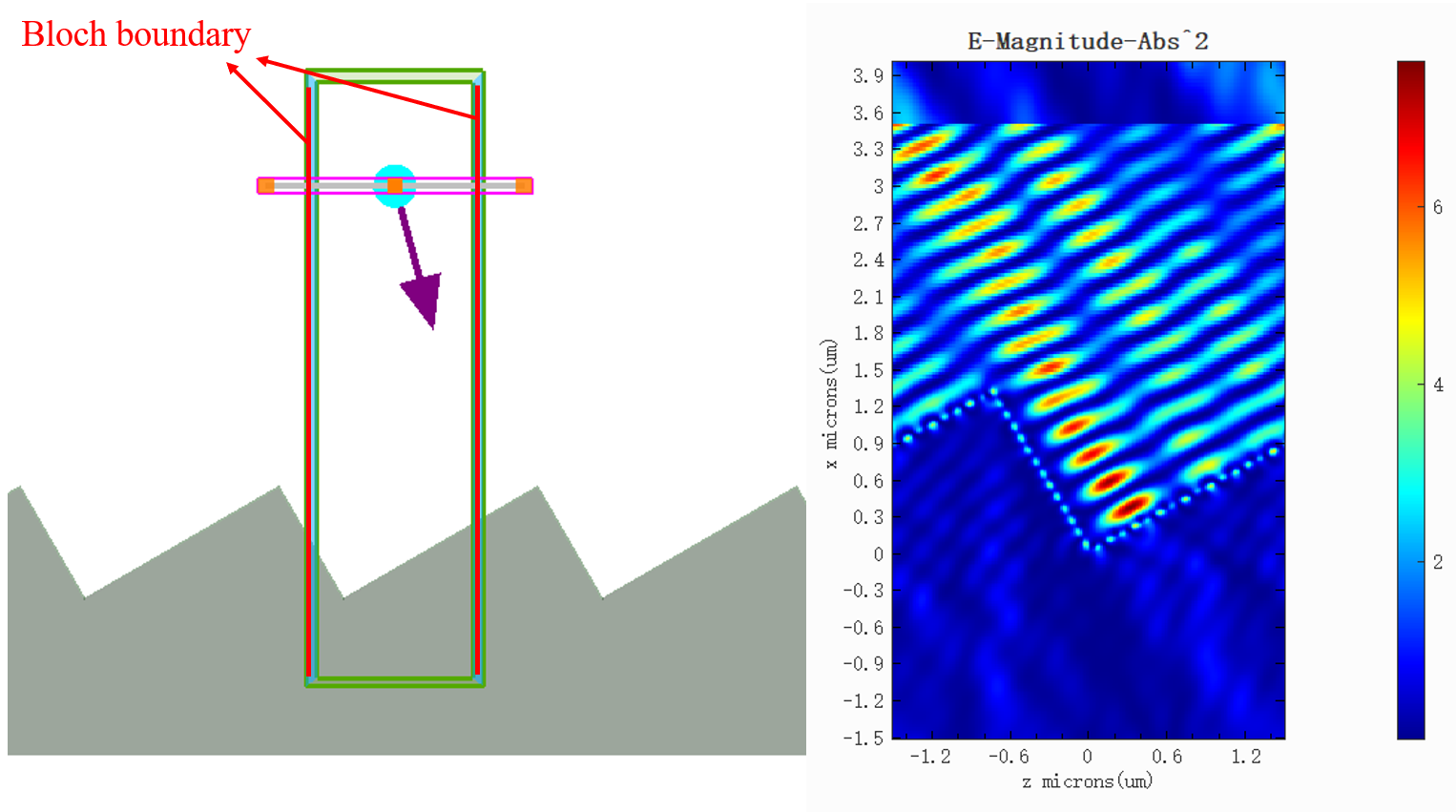
Bloch boundary conditions are an extension of periodic boundary conditions and are used to handle periodic structures under phase-shifted excitation. They are mainly applied in cases where a plane wave is incident at a finite angle, where the electromagnetic field must maintain phase continuity between adjacent periodic cells, or where band-structure and dispersion analysis is required.
Basic concept #
Bloch boundary conditions are a generalization of periodic boundaries. Their core idea is to preserve phase continuity between adjacent periodic cells instead of requiring the field to be exactly identical after translation. This is necessary when the structure is periodic but the excitation includes a finite incident angle, a propagation phase shift, or a wave vector that is not aligned with the lattice normal.
It can be expressed as:
Exmax=e−ikxaxExmin
where kx is the Bloch wave-vector component along the x direction, and ax is the lattice period in that direction. In a general 3D form, this becomes:
E(r+a)=eik⋅aE(r)
where k is the Bloch wave vector and a is the lattice translation vector. This relation shows that neighboring cells are not simply identical after translation; instead, they are related by a phase factor that preserves the correct propagation direction and phase relation of the Bloch mode.
In practice, Bloch boundaries are used in oblique-incidence plane-wave problems, angle-dependent dispersion calculations, band-structure analysis, and any periodic problem where the phase of the field must be kept consistent with the lattice. The key requirement is that the phase relationship between neighboring cells is preserved rather than replaced by an unshifted periodic mapping.
Applicable scenarios #
Bloch boundaries are suitable for:
- plane waves incident on a periodic structure at a finite angle;
- analyses where the incident direction and the periodic phase relation must be preserved;
- band-structure, dispersion, and angle-dependent periodic problems.
Usage requirements #
- When the incidence is normal and there is no phase shift, the Bloch boundary degenerates into the periodic boundary; periodic boundary conditions can be regarded as a special case of Bloch boundary conditions with zero phase offset.
- The upper and lower boundaries in the same direction must be consistent for both types.
- In FDTD, the Bloch boundary is typically evaluated for a single frequency point at the specified angle. For broadband or angle-dependent studies, combine it with the built-in sweep function to obtain correct frequency-dependent or angle-dependent results. See Sweep.
- The Using source angle option is selected by default. In this mode, the Bloch wave vector is calculated automatically from the source angle. If this option is disabled, the user must define the kx, ky, and kz components manually.
| Name | Description |
|---|---|
| kx/ky/kz | The component of the wave vector k along x/y/z. |
Notes #
- Use periodic boundaries when incidence is normal and no phase offset exists; for oblique incidence or non-zero phase offsets, use Bloch boundaries to preserve phase continuity.
- Band-structure and dispersion analyses require coordinating frequency sweeps with the Bloch wave vector (k) to ensure physically meaningful results.
- The "Using source angle" option can automatically compute the Bloch wave vector from the source angle; if disabled, the user must specify k components manually.
- Ensure the selected k matches the source angle and lattice parameters to avoid inconsistent settings.