

Application Gallery
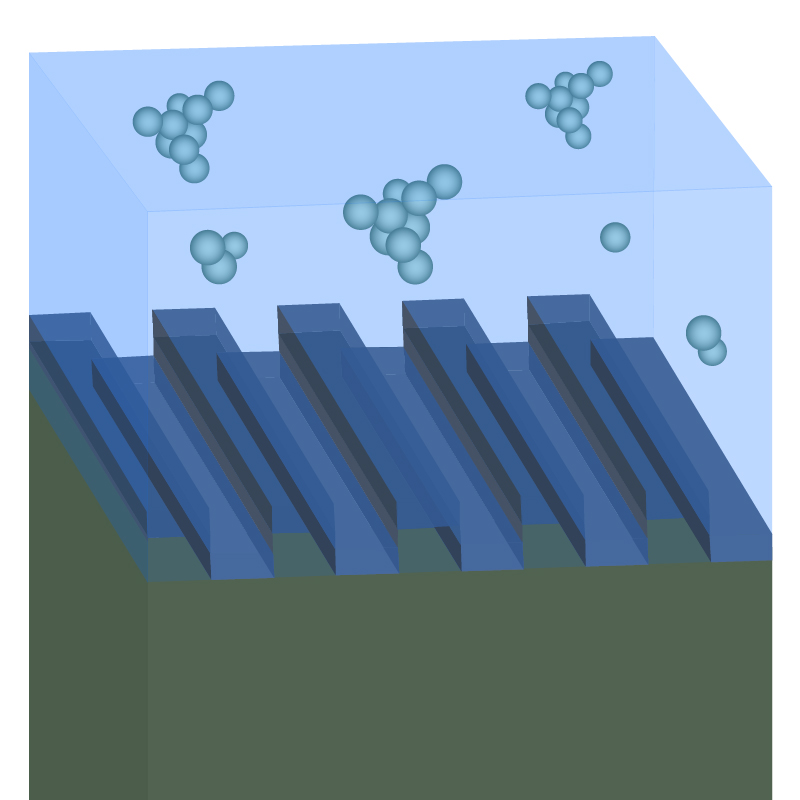
Resonant Bio-sensor Grating
In modern biosensing technologies, sensors based on optical resonant structures have attracted considerable attention due to their high sensitivity and label-free detection capability. As a representative nanoscale photonic element, resonant grating structures enable high-precision sensing by monitoring shifts in the resonance peaks of their reflection or transmission spectra in response to subtle variations in the surrounding refractive index. This property makes them highly attractive for applications in biomolecular recognition, environmental monitoring, and medical diagnostics. In this case study, following the work of *Cunningham et al.[^1]*, a representative resonant biosensor grating is modeled and simulated, and its optical response characteristics are analyzed.
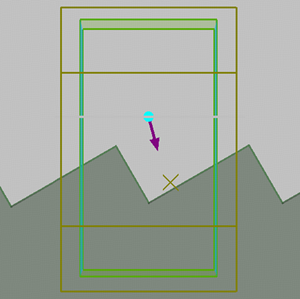
Blazed Grating
The blazed grating is a specially optimized diffractive structure designed to efficiently direct most of the incident light energy into a designated diffraction order by introducing a blaze angle on the grating surface. This significantly improves diffraction efficiency while suppressing unwanted orders. In this case study, an `FDTD` simulation is performed on a blazed grating to analyze its energy distribution among different diffraction orders.
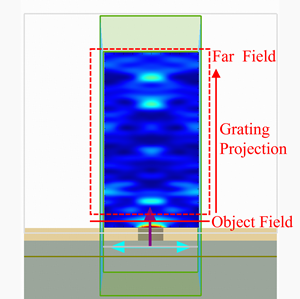
Using grating projections calculate fields at an arbitrary location
In FDTD simulations, obtaining the field distribution at locations far from a device usually requires expanding the simulation domain so that light can fully propagate to the target plane. While this approach is straightforward, it significantly increases computational cost and simulation time. This case presents a Grating Projection(GP)–based approach that can quickly obtain the distribution of fields propagating in homogeneous media at any specified location, and verifies its accuracy through comparison with FDTD simulation results.
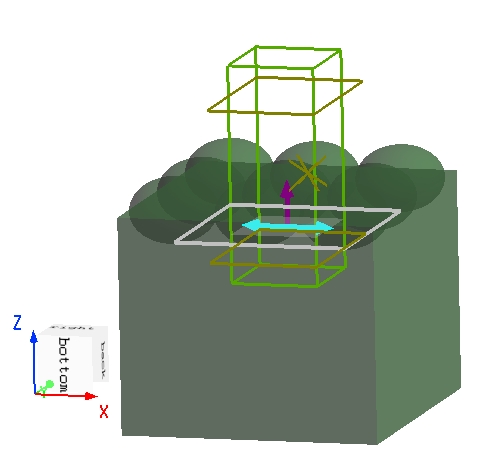
Diffraction Grating
The Diffraction grating is a classic type of periodic optical element, widely used in fields such as spectroscopy, laser beam control, and beam splitting. Their functionality relies on spatially modulating the wavefront of incident light to generate a series of discrete diffraction orders in specific directions. Since a grating's performance is governed by its diffraction-order energy distribution, precise quantification of this distribution becomes critical for design optimization. This case demonstrates how to use the grating projection functions in an FDTD simulation of a two-dimensional periodic grating, allowing for accurate evaluation of the energy distribution among diffraction orders and their corresponding efficiencies.
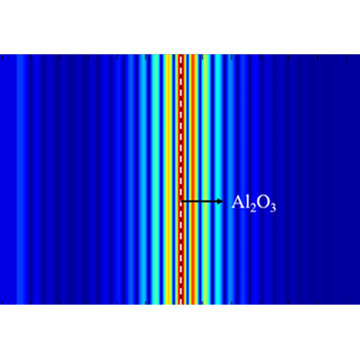
Tamm Plasmon Polaritons Generated by Bragg Grating
In 2007, Kaliteevski et al. successfully excited Tamm plasmon polaritons (TPPs) between metal and Bragg gratings. The TPPs can be directly excited since the dispersion curves of TPPs lie within the light cone. Additionally, both TE and TM polarized light can be stimulated in TPPs since there is no requirement for the angle of incidence. These characteristics make TPPs popular in the fields such as surface light enhancement, nonlinear optics, and lasers. This case will simulate and study this process.
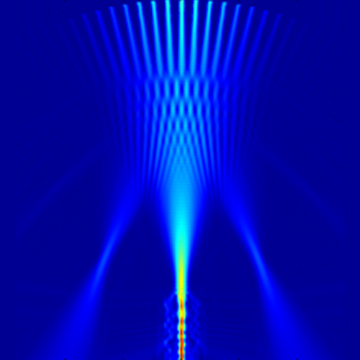
Si-Based Arrayed Waveguide Grating
Arrayed waveguide gratings (AWGs) are essential components in dense wavelength division multiplexed (DWDM) systems. As large-scale photonic integrated devices continue to evolve, the miniaturization design of AWGs has become an important topic. In this example, a 2.5D-FDTD solver in SimWorks Finite Difference Solutions was employed to simulate a saddle-shaped silicon nanowire AWG to investigate its output spectral response and loss.
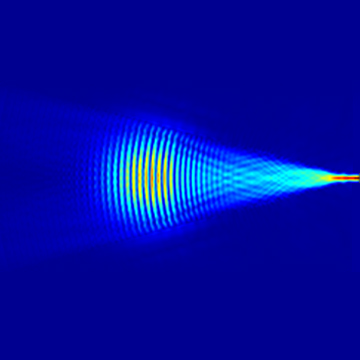
Focusing Grating Coupler
One important issue of silicon photonic circuit is an interface between integrated waveguide devices and optical fibers or free-space optics. Grating couplers have the advantages of easy fabrication, high flexibility, and large alignment tolerance, which makes them the most important solution to solve the coupling issues. In this example, we simulate a focusing grating coupler to study its coupling capability.
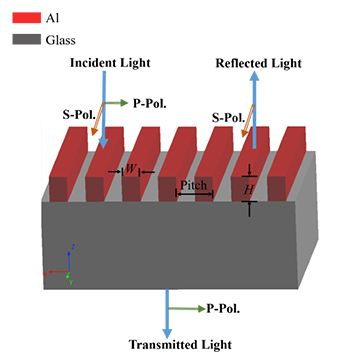
Wire Grid Polarizer
Wire grid polarizer(WGP) is a type of polarizer composed of a metallic grating with a sub-wavelength period and typically made of metals such as gold, silver, aluminum. Due to their advantages, including compact structure, high brightness, high polarization extinction ratio (PER), wide field of view, and ease of integration, WGPs can be widely applied in various fields such as photoswitches, optical displays, and imaging systems. This case is based on the work of Ahn et al. By controlling the grating spacing, duty cycle, and Al grating height, the extinction ratio and transmission optical characteristics can be adjusted.
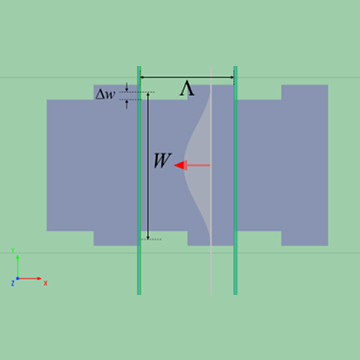
Bragg Grating Based on FDTD
A Bragg grating is an optical device in which there is a periodic variation in the effective refractive index of the structure. The waveguide Bragg grating is a type of one-dimensional photonic crystal structure that enables wavelength selection through periodic modulation of the refractive index. The impact of the geometrical parameters of the sidewall corrugation, such as depth or misalignment, on the performance of Bragg gratings can be analyzed in silicon waveguide Bragg gratings, as demonstrated by Wang et al.