

Application Gallery

Bulls eye aperture
The bull’s-eye aperture is a metallic subwavelength optical structure characterized by a central circular hole surrounded by periodically distributed concentric grooves. When incident light illuminates the metal surface, the concentric slits excite surface plasmon polaritons (SPPs) at specific wavelengths, which are re-radiated through the central aperture to the opposite side, resulting in strong transmission and significant field enhancement. In this case study, a bull’s-eye aperture fabricated on a silver film is simulated to demonstrate its characteristic field enhancement and directional radiation effects.

Focusing with a single subwavelength aperture
Subwavelength optical devices hold great potential in light field manipulation and photonic integration. However, at subwavelength scales, light undergoes strong interference and diffraction, making it difficult to achieve efficient focusing. Garcia-Vidal et al proposed a structure consisting of a single subwavelength aperture in a metallic film surrounded by periodic surface grooves. By exciting surface plasmons, this design enables far-field focusing. In this case, we reproduce the structure with FDTD simulations and analyze the focal spot size to demonstrate its focusing capability.
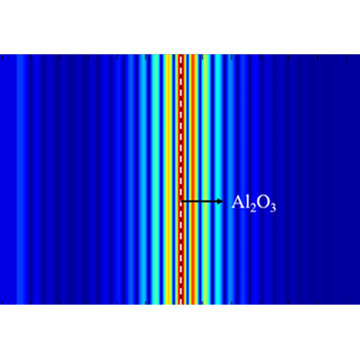
Tamm Plasmon Polaritons Generated by Bragg Grating
In 2007, Kaliteevski et al. successfully excited Tamm plasmon polaritons (TPPs) between metal and Bragg gratings. The TPPs can be directly excited since the dispersion curves of TPPs lie within the light cone. Additionally, both TE and TM polarized light can be stimulated in TPPs since there is no requirement for the angle of incidence. These characteristics make TPPs popular in the fields such as surface light enhancement, nonlinear optics, and lasers. This case will simulate and study this process.
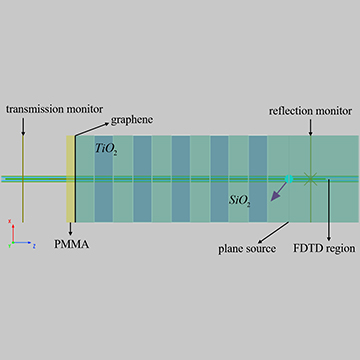
Exciting the Surface Plasmon-Polaritons in Graphene
The chemical potential of graphene can be regulated by methods such as voltage or chemical doping. This property makes graphene highly versatile in the field of material-light interactions, particularly in relation to surface plasmon polaritons (SPPs). By exciting surface plasmons, graphene significantly enhances its ability to interact with light.
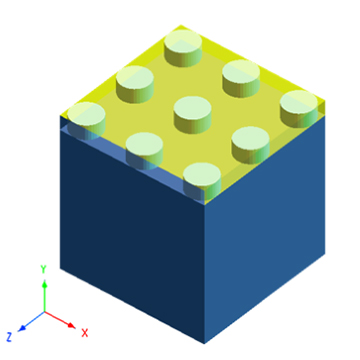
Nanohole Array
The interaction between incident light and surface electrons of a metallic nanostructure leads to surface plasmon resonance (SPR), which exhibits unique optical properties, including out-of-limit diffraction and local field enhancement. This case involves building a model of a metal film structure with air-hole array and calculating the transmission and reflection spectra of the film by the FDTD method to analyze the near-field distribution on the film surface and the local field enhancement caused by SPR.
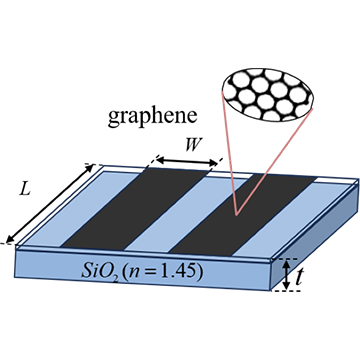
Tunable Terahertz Metamaterials Based on Graphene
Graphene is a single-layer carbon material that is only one atom thick. It can be used in nanoscale plasmon systems due to its unique physical properties. Light can be manipulated and controlled by adjusting the electrostatic doping or Fermi level to excite plasmon waves in single-layer graphene. According to the research by Chu et al., slight variations in the number of graphene layers and Fermi level can lead to significant changes in the resonant wavelength and modulation intensity. This case aims to simulate this tuning process in 3D FDTD.
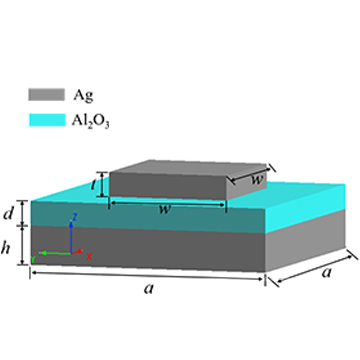
Plasmonic Metamaterial Infrared Absorber
Metamaterial is a special type of man-made material with extraordinary physical properties that natural materials do not have, such as regulating the frequency, amplitude, phase, etc. of electromagnetic waves. This case models and simulates a Metal-Insulator-Metal (MIM) plasmonic metamaterial infrared absorber to study its reflection/transmission/absorption characteristics in the visible to near-infrared band.