

Application Gallery
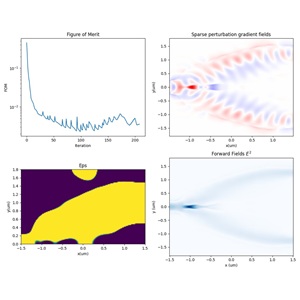
2D Y-Branch Based on Topology Driven Design
In this case, we apply the topology optimization (TO) method to the design of a two-dimensional Y‑branch splitter. By directly optimizing the material distribution within the design region and allowing the algorithm to explore freely throughout the design space, we demonstrate the powerful capability of topology‑based inverse design in both structural generation and performance optimization of photonic devices.
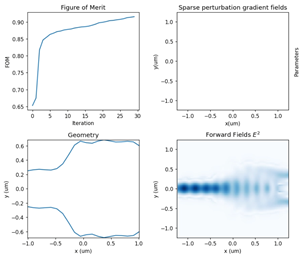
Inverse Design of Y Branch
In this case, we demonstrate a Y-branch splitter and how automatic geometric optimization can be achieved using parameterized structural descriptions. The algorithm automatically adjusts the control points of the parameterized structure, enhancing both design efficiency and device performance.

Polarization Converter Using A Tapered Waveguide
The tapered-waveguide-type polarization converter achieves efficient polarization conversion by enabling smooth energy coupling between different polarization modes through a gradually varying waveguide cross-section along the propagation direction. This structure offers advantages such as broad bandwidth, low loss, and high tolerance to fabrication errors, making it widely used in optical communications, polarization multiplexing, and polarization control in silicon photonic chips. In this example, the FDE solver is first used to sweep the waveguide width and analyze the variation of the effective refractive index of the TM1 and TE0 modes, identifying the region where the two modes intersect to guide the design range of the tapered waveguide. Subsequently, the FDTD solver is employed to perform a three-dimensional simulation of the entire structure to calculate the light propagation and polarization conversion efficiency within the tapered waveguide.
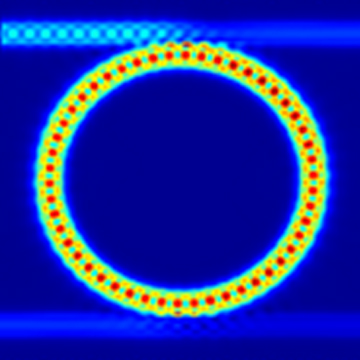
Silicon Based Double Straight Waveguide Microring Resonator
Integrated photonics has become a key enabling technology in areas such as optical communications, sensing, and signal processing. Among various photonic devices, microring resonators are widely used in applications such as filtering, modulation, and nonlinear optics due to their compact footprint, high quality factor, and excellent wavelength-selective properties. In this case, we design and simulate a microring resonator with a center wavelength of 1.55 um and a free spectral range (FSR) of 3200 GHz.

Multi-Mode Interference (MMI) Coupler
The Multi-mode Interference (MMI) coupler is composed of three parts (input waveguide, output waveguide, and multimode interference region). When the optical field is injected into the multimode interference region through the input waveguide, the interference between multiple modes produces a self-imaging effect. This effect causes periodic generations of one or more images of the input field along the propagation direction of the guided wave. As a result, the MMI can achieve optical wavelength division multiplexing/demultiplexing, power division, polarizing splitter and other functions by this effect.
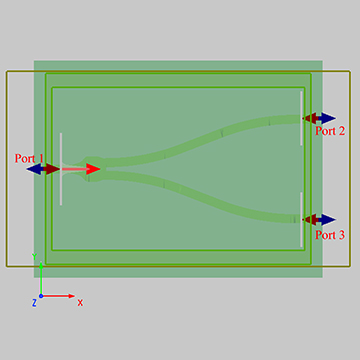
Y Branch
The power splitter based on Y branch distributes optical power to two or more output devices in a certain ratio. In this example, we use SimWorks Finite Difference Solutions to simulate the insertion loss, transmitted power and S-parameters of a symmetric 50/50 Y-branch splitter.