

Application Gallery
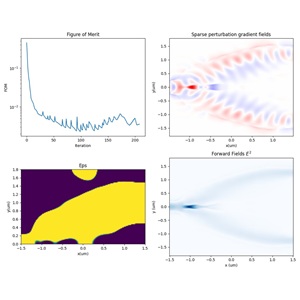
2D Y-Branch Based on Topology Driven Design
In this case, we apply the topology optimization (TO) method to the design of a two-dimensional Y‑branch splitter. By directly optimizing the material distribution within the design region and allowing the algorithm to explore freely throughout the design space, we demonstrate the powerful capability of topology‑based inverse design in both structural generation and performance optimization of photonic devices.
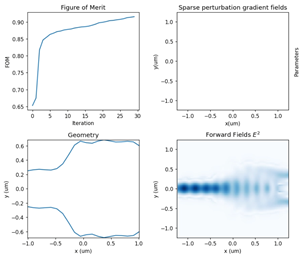
Inverse Design of Y Branch
In this case, we demonstrate a Y-branch splitter and how automatic geometric optimization can be achieved using parameterized structural descriptions. The algorithm automatically adjusts the control points of the parameterized structure, enhancing both design efficiency and device performance.
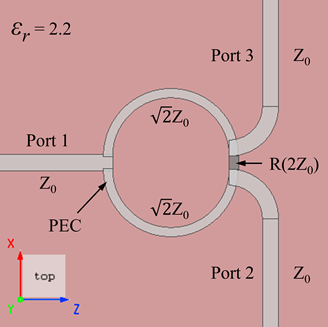
Wilkinson Power Divider
The Wilkinson power divider is a three-port device used for power distribution. Compared to a conventional T-junction power divider, it can match all ports and achieve arbitrary power distribution. Unlike resistive power dividers, the Wilkinson power divider not only can isolate the output ports but also indicate no loss when the ports are matched, only dissipating reflections from the output ports. This case models and simulates an equal-split (3dB) Wilkinson power divider designed in Example 7.2 from Pozar.
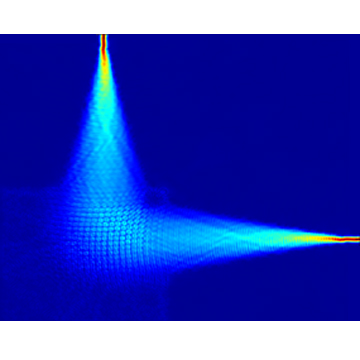
Focusing Polarization Splitting Grating Coupler
The grating coupler has emerged as crucial components in silicon nanophotonics. Addressing the coupling issue between optical fibers and waveguides has become a prominent research focus in recent years. Polarization splitting grating couplers in this case can simultaneously achieve polarization beam-splitting and light coupling functions, which enables the vertical grating coupling between fibers and Silicon-On-Insulator platform for various polarization states. This approach represents one of the most optimal solutions to tackle this issue.

Multi-Mode Interference (MMI) Coupler
The Multi-mode Interference (MMI) coupler is composed of three parts (input waveguide, output waveguide, and multimode interference region). When the optical field is injected into the multimode interference region through the input waveguide, the interference between multiple modes produces a self-imaging effect. This effect causes periodic generations of one or more images of the input field along the propagation direction of the guided wave. As a result, the MMI can achieve optical wavelength division multiplexing/demultiplexing, power division, polarizing splitter and other functions by this effect.
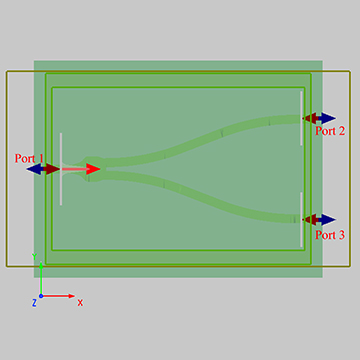
Y Branch
The power splitter based on Y branch distributes optical power to two or more output devices in a certain ratio. In this example, we use SimWorks Finite Difference Solutions to simulate the insertion loss, transmitted power and S-parameters of a symmetric 50/50 Y-branch splitter.