

Application Gallery

Focusing with a single subwavelength aperture
Subwavelength optical devices hold great potential in light field manipulation and photonic integration. However, at subwavelength scales, light undergoes strong interference and diffraction, making it difficult to achieve efficient focusing. Garcia-Vidal et al proposed a structure consisting of a single subwavelength aperture in a metallic film surrounded by periodic surface grooves. By exciting surface plasmons, this design enables far-field focusing. In this case, we reproduce the structure with FDTD simulations and analyze the focal spot size to demonstrate its focusing capability.
Metalens Based on PB Phase
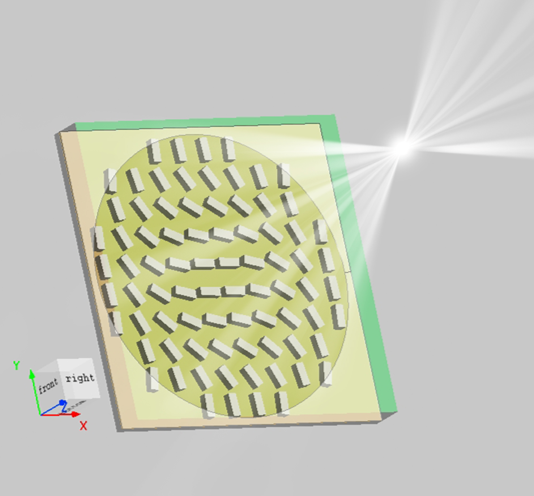
Traditional curved optical lenses rely on phase accumulation along the light path to control light, which is limited by the refractive index of natural materials. To correct various image aberrations, multiple lenses are usually needed. However, combining multiple optical lenses occupies a lot of space, making it difficult to miniaturize optical systems. Metalenses, however, manipulate incident light to bend beams through the arrangement of artificial sub-wavelength units on the dielectric surface. A single metalens can achieve the same performance as a device that requires multiple optical lenses. Compared to traditional optical lenses, metalenses are smaller, lighter, cheaper, have better imaging quality, and are easier to integrate. They provide a new solution for compact integrated optical systems. This case study, based on the research of Xicheng Xia and Zan Yao, introduces how to use FDTD to simulate metalenses, helping readers achieve miniaturization of optical systems.