
<< back to the application gallery
Resonant Bio-sensor Grating
2025-12-30 09:52:51
  • FDTD
  • Grating
  • Resonator

Preface

In modern biosensing technologies, sensors based on optical resonant structures have attracted considerable attention due to their high sensitivity and label-free detection capability. As a representative nanoscale photonic element, resonant grating structures enable high-precision sensing by monitoring shifts in the resonance peaks of their reflection or transmission spectra in response to subtle variations in the surrounding refractive index. This property makes them highly attractive for applications in biomolecular recognition, environmental monitoring, and medical diagnostics.

In this case study, following the work of Cunningham et al.[1], a representative resonant biosensor grating is modeled and simulated, and its optical response characteristics are analyzed.

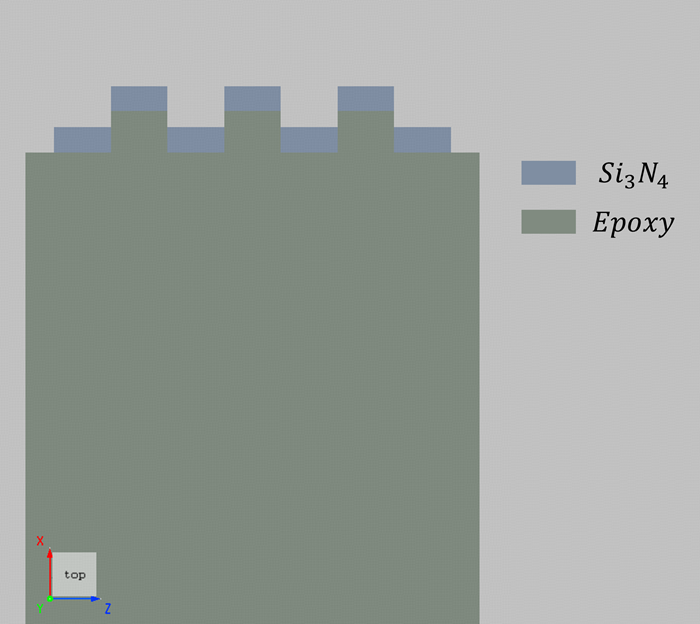
grating_silicon_nitride_structure

Simulation settings

Device introduction

The device structure used in this case study is shown in the figure above. The substrate material is epoxy, resin with a refractive index of n=1.5n=1.5. A periodic grating structure is constructed on the surface of the substrate, with a grating period of 0.55 μm0.55\ \mu m and a height of 0.2 μm0.2\ \mu m. A silicon nitride layer with a thickness of 0.12 μm0.12\ \mu m is deposited on top of the grating. The entire device structure is immersed in water, which can be implemented in the FDTD simulation by setting the background refractive index to 1.3331.333.

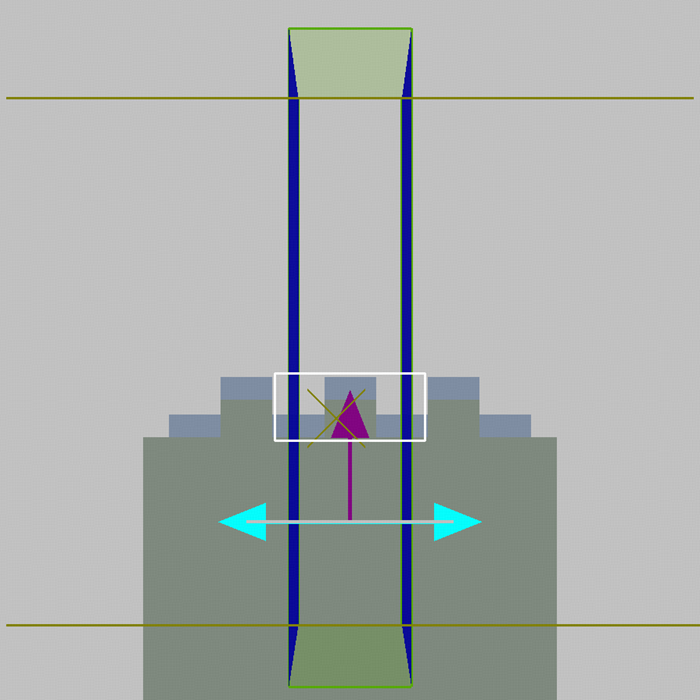
A plane-wave source with a wavelength range of 0.750.9 μm0.75-0.9\ \mu m is used in the simulation, and the source is normally incident onto the structure along the positive XX-axis direction. Periodic boundary conditions are applied in the ZZ direction, so that the electromagnetic response of an infinitely periodic structure in this direction can be obtained by simulating a single period. The structure exhibits pronounced resonant behavior, with a relatively long decay time of the resonant modes; however, the energy involved in the resonance accounts for only a very small fraction of the total injected energy. Therefore, the auto shutoff criterion is set to 1e091e-09 in the simulation to ensure sufficient convergence of the resonant process.

grating_silicon_nitride_simulation

Simulation results

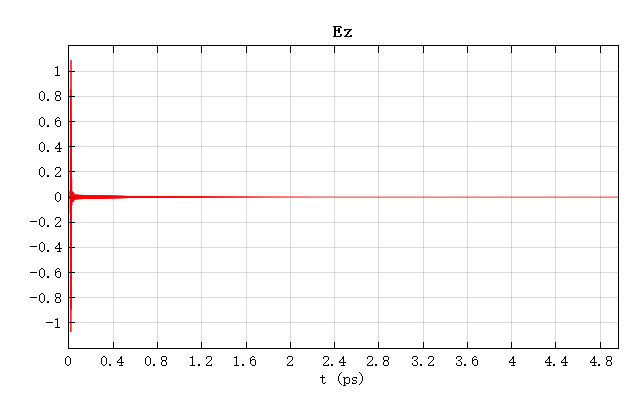
After the simulation is completed, the temporal evolution of the electric field component EzEz in the grating structure is shown in the figure below. It can be observed that the field amplitude decays sufficiently to nearly zero after the excitation ends, indicating that the resonant modes in the system have fully decayed. This confirms that the simulation time is sufficient and that the frequency-domain results recorded by the monitors are well converged and reliable.

grating_silicon_nitride_Ez

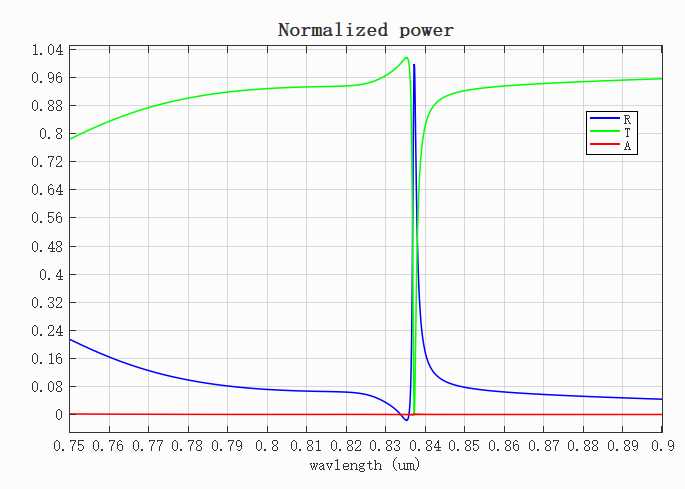
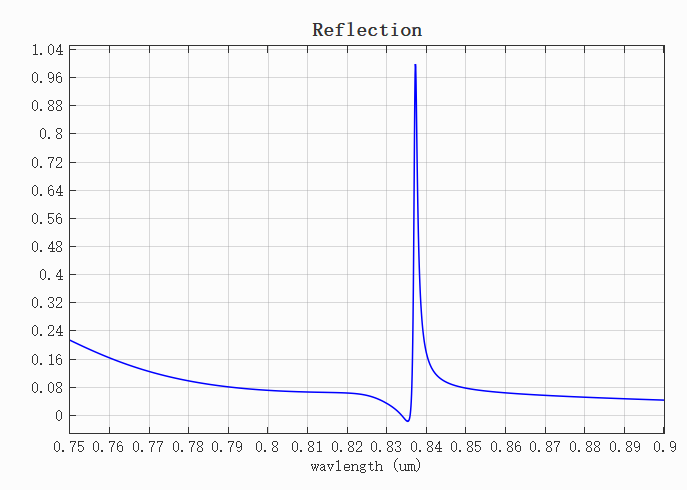
Based on this, the attached grating_silicon_nitride.msf script is executed to calculate and plot the reflection (RR), transmission (TT), and absorption (AA) spectra of the device as functions of wavelength, as shown in the figure below. A pronounced and sharp resonance peak appears at a wavelength of approximately 0.839 μm0.839\ \mu m, where the reflectance approaches unity, indicating that the incident light is almost completely reflected, while both the transmission and absorption drop to very low levels. This behavior demonstrates that a strong resonant mode is excited in the structure at this wavelength.

grating_silicon_nitride_ART

The reflection spectrum alone is plotted in the figure below. It can be seen that the simulation results are in close agreement with the experimental results presented in Figure 3 of the work by Cunningham et al.[1:1]. The small discrepancies may arise from differences between the refractive indices of the actual materials and those used in the simulation, as well as from fabrication imperfections in the device.

grating_silicon_nitride_R

To evaluate the refractive-index sensing performance of the resonant biosensor grating, practical sensor characterization typically requires scanning multiple biological solutions or a range of refractive-index conditions, followed by multipoint fitting to obtain the average sensitivity of the sensor. In this case, the background refractive index in the FDTD simulation is replaced from water to physiological saline with a refractive index of n=1.3345n=1.3345, solely for the purpose of demonstrating the evaluation methodology.

The frequency sensitivity of the sensor is defined as:

Sf=ΔfΔn (GHz/RIU)S_f=\frac{\Delta f}{\Delta n}\ (GHz/RIU)

where RIU (Refractive Index Unit) is the conventional unit used to quantify refractive index changes when evaluating the sensitivity of optical sensors.

After executing the grating_silicon_nitride.msf script, the sensitivity of the resonant biosensor grating is automatically displayed in the script command window, as shown below:

The frequency sensitivity of the sensor is 42616.9 GHz/RIU

The results indicate that, as the refractive index of the surrounding medium increases, the resonance peak exhibits a red shift. The corresponding frequency sensitivity reaches 42616.9GHz/RIU42616.9 GHz/RIU, demonstrating that the resonant mode is highly sensitive to changes in the ambient refractive index.

References


  1. Cunningham et al., "A plastic colorimetric resonant optical biosensor for multiparallel detection of label-free biochemical interactions", Sensors and Actuators B: Chemical, 85, 219–226 (2002). ↩︎ ↩︎

Documents
Login to download
In this article
Top
Documents
Login to download